
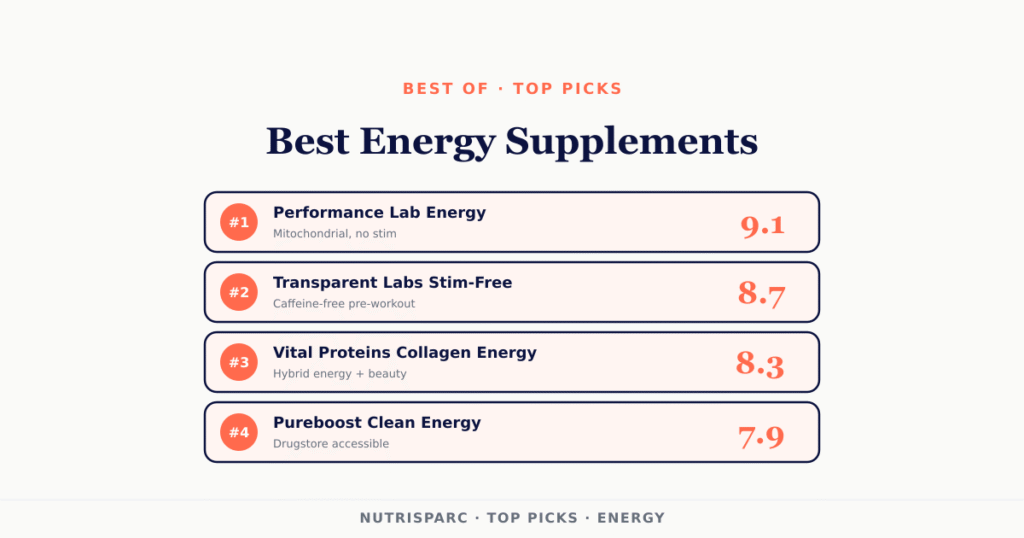
We compared over a dozen energy products to find the best energy supplements that actually deliver — without relying on jittery caffeine doses or proprietary blends. Every product was evaluated using our published six-criteria methodology: ingredient quality, dosage transparency, safety profile, third-party testing, value for money, and overall fit.
Below are our four picks across four use cases: stim-free daily energy, caffeine-free pre-workout, hybrid energy + beauty, and accessible drugstore. Ranked by overall score.
| Rank | Product | Score | Best For | Review |
|---|---|---|---|---|
| #1 | Performance Lab Energy | 9.1 | Best overall — mitochondrial support, no stim | — |
| #2 | Transparent Labs Stim-Free | 8.7 | Best pre-workout — caffeine-free, fully disclosed | Read Review |
| #3 | Vital Proteins Collagen Energy | 8.3 | Best hybrid — collagen + caffeine + B vitamins | Read Review |
| #4 | Pureboost Clean Energy | 7.9 | Best drugstore — vitamins/minerals, accessible | Read Review |
Performance Lab Energy
Performance Lab Energy is one of the more thoughtfully formulated stim-free energy supplement in our reviews. Instead of forcing alertness through caffeine, it targets the mitochondria — the cellular machinery that produces ATP, the body’s primary energy currency — with bioavailable CoQ10 (MicroActive Q10), PQQ for mitochondrial biogenesis, ALCAR for fatty acid transport, and Bio-Enhanced R-Lipoic Acid. The result is sustainable energy without the crash, dependency, or jitter associated with stimulant-based products. Best for adults with cognitively demanding work who want consistent daily energy.
Transparent Labs Stim-Free
Transparent Labs Stim-Free is our top pick caffeine-free pre-workout. Every ingredient is fully disclosed at clinically relevant doses — 6g of citrulline malate, 4g of beta-alanine, 2.5g of betaine anhydrous — with no proprietary blends, artificial colors, or sweeteners. For athletes who train late in the day, who are sensitive to stimulants, or who simply want pump and endurance support without the cardiovascular load of high-dose caffeine, this is the most rigorous formula in its category.
Vital Proteins Collagen Energy
Vital Proteins Collagen Energy is the only product in our ranking that combines collagen peptides for skin, hair, and joint support with a moderate dose of natural caffeine and a B-complex for daily energy. For users who already take collagen and want a single-format morning routine — or who want a gentler caffeine source than coffee — this hybrid format is uniquely positioned. The trade-off is that mid-tier caffeine doses make it less ideal for evening use.
Pureboost Clean Energy
Pureboost Clean Energy is the best caffeine-free accessible energy supplement. The formula relies on B vitamins, Vitamin C, electrolytes, and antioxidants in a single-serve drink mix — no artificial sweeteners, no artificial colors, no proprietary blends. For users who want a clean energy product at a fraction of premium pricing, or who are sensitive to caffeine entirely, this is the most rigorous budget option in the category.
How We Chose the Best Energy Supplements
Every product in this ranking was evaluated using our six-criteria methodology: ingredient quality, dosage transparency, safety profile, third-party testing, value for money, and overall fit. No product is included based on affiliate relationships — our scores are assigned independently before any commercial consideration.
We deliberately focused on supplements that target real energy mechanisms — mitochondrial function, micronutrient gaps, and pre-workout performance — rather than pure stimulant blends. Caffeine has its place, but most consumers already get caffeine from coffee, tea, or pre-existing routines. A “best energy supplement” list dominated by high-dose caffeine products would simply duplicate something readers already do, often at the cost of sleep quality, anxiety, and cardiovascular load.
What this list isn’t
This isn’t a roundup of every energy supplement on the market. It’s our four current picks across four user fits — stim-free daily, caffeine-free pre-workout, hybrid energy + beauty, and accessible drugstore. If you have persistent fatigue despite adequate sleep, a supplement isn’t the right first step. The right first step is bloodwork with a clinician — common contributors like iron deficiency, low Vitamin D, B12 deficiency, or thyroid issues need to be ruled out before supplement experimentation. The best energy supplements work alongside good sleep, nutrition, and movement habits, not as a replacement for them.
- Caffeine addresses symptoms of fatigue — not root causes
- Mitochondrial support is the most sustainable long-term energy approach
- B vitamin deficiency is a common, overlooked contributor to everyday tiredness
- Pre-workout and daily energy supplements serve different purposes — choose accordingly
- Proprietary blends in energy supplements are a major red flag
The Three Categories of Energy Supplements
Not all energy supplements work the same way. Before choosing a product, it helps to understand which category matches your actual energy goal.
1. Stimulant-Based Energy
Caffeine and other stimulants work by blocking adenosine receptors — the receptors that signal tiredness to the brain. The result is temporary alertness and reduced perception of fatigue. Stimulant-based supplements include pre-workouts, energy drinks, and caffeine pills. They are effective for acute energy needs but do not address the underlying causes of fatigue and carry dependency and tolerance risks with consistent use.
2. Mitochondrial Energy Support
Mitochondrial supplements target the cellular machinery responsible for producing ATP — the body’s primary energy currency. Rather than masking fatigue, they support the body’s actual energy production capacity. Ingredients like CoQ10, PQQ, and ALCAR fall into this category. Results are slower to develop but more sustainable and do not carry stimulant dependency risks.
3. Micronutrient Energy Support
B vitamin deficiency, Vitamin D deficiency, and iron deficiency are among the most common nutritional causes of fatigue. Micronutrient-based energy supplements address these deficiencies directly. They are the lowest-intensity category but highly effective for users whose fatigue is rooted in nutritional gaps rather than performance demands.
Key Ingredients to Look For
CoQ10 (Coenzyme Q10)
CoQ10 is essential for mitochondrial electron transport and ATP production. Natural CoQ10 levels decline with age and with statin use — making supplementation particularly relevant for older users and those on cholesterol medication. Look for enhanced bioavailability forms like MicroActive Q10 or ubiquinol rather than standard ubiquinone.
PQQ (Pyrroloquinoline Quinone)
PQQ stimulates mitochondrial biogenesis — the creation of new mitochondria. More mitochondria means greater cellular energy production capacity. At 10–20mg, PQQ is one of the most compelling mitochondrial support ingredients available.
ALCAR (Acetyl-L-Carnitine)
ALCAR transports fatty acids into mitochondria for conversion to ATP. It supports both physical energy and cognitive function, making it a versatile addition to any energy formula. Look for the Acetyl-L form rather than standard L-Carnitine for superior brain bioavailability.
Citrulline Malate
Citrulline Malate is the primary pump ingredient in stimulant-free pre-workouts. It converts to Arginine in the kidneys, driving nitric oxide production and vasodilation. At 6–8g, it significantly improves blood flow, training pump, and endurance. Less than 6g is generally considered underdosed.
B Vitamins
B6, B12, and B5 (Pantothenic Acid) are essential cofactors for the enzymatic conversion of food into ATP. B12 deficiency in particular is extremely common — especially in vegans and vegetarians — and causes significant fatigue, brain fog, and mood disruption.
Red Flags to Avoid
- All ingredient doses fully disclosed
- Clinically relevant ingredient forms specified
- Third-party tested for purity
- Clear category fit — daily vs pre-workout
- Realistic claims about effects and timeline
- Proprietary blends — hidden doses
- Unrealistic claims (“all-day energy instantly”)
- Excessive caffeine (400mg+) per serving
- No third-party testing or GMP certification
- Artificial colors, sweeteners, and fillers
Compare the Options Head-to-Head
Still weighing two energy picks against each other? These side-by-side comparisons break down dosing, form, third-party testing, and who each option suits best:
- Performance Lab Energy vs Transparent Labs Stim-Free — Two stimulant-free formulas compared head-to-head.
- Performance Lab Energy vs Pureboost Clean Energy — A mitochondrial stack versus a budget vitamin mix.
What are the best energy supplements without caffeine?
Based on our scoring, Performance Lab Energy is the best caffeine-free energy supplement overall. It targets mitochondrial ATP production with CoQ10, PQQ, and ALCAR rather than masking fatigue with stimulants. For pre-workout use without caffeine, Transparent Labs Stim-Free is our top pick. For an accessible drugstore option, Pureboost Clean Energy delivers B vitamins, Vitamin C, and electrolytes without artificial ingredients.
Can I take energy supplements every day?
Daily use is appropriate for mitochondrial support supplements (like Performance Lab Energy) and micronutrient-based formulas (like Pureboost Clean Energy). Pre-workout supplements like Transparent Labs Stim-Free are best reserved for training days. High-caffeine products should be cycled to prevent tolerance buildup and to protect sleep quality.
Why am I always tired despite sleeping enough?
Persistent fatigue despite adequate sleep can have many causes — including B12 deficiency, Vitamin D deficiency, iron deficiency, thyroid issues, or poor mitochondrial function. A blood panel with your healthcare provider is the best starting point before turning to supplements. If your bloodwork is clear, mitochondrial support formulas address energy at the cellular production level rather than masking symptoms.
Are energy supplements better than coffee?
It depends on the goal. For acute alertness on a specific day, coffee is hard to beat — it is cheap, effective, and well-tolerated by most adults. For sustained daily energy, especially in adults who are already caffeine-tolerant or caffeine-sensitive, a stim-free mitochondrial supplement like Performance Lab Energy addresses energy production at a different mechanism than caffeine. The two are not mutually exclusive — many users combine moderate caffeine with mitochondrial support.
Sources
- National Institutes of Health, Office of Dietary Supplements — Vitamin B12 fact sheet.
- National Institutes of Health, Office of Dietary Supplements — Iron fact sheet.
- Hultman E. et al. (1996). Muscle creatine loading in men. Journal of Applied Physiology — foundational creatine loading research.
- Wesnes K.A. et al. (2017). An evaluation of the cognitive and mood effects of an energy shot over a 6-h period in volunteers. Appetite — caffeine + B vitamins synergy.
- Examine.com — Caffeine reference page.
New to this category? Start with our How to Choose an Energy Supplement buying guide.