
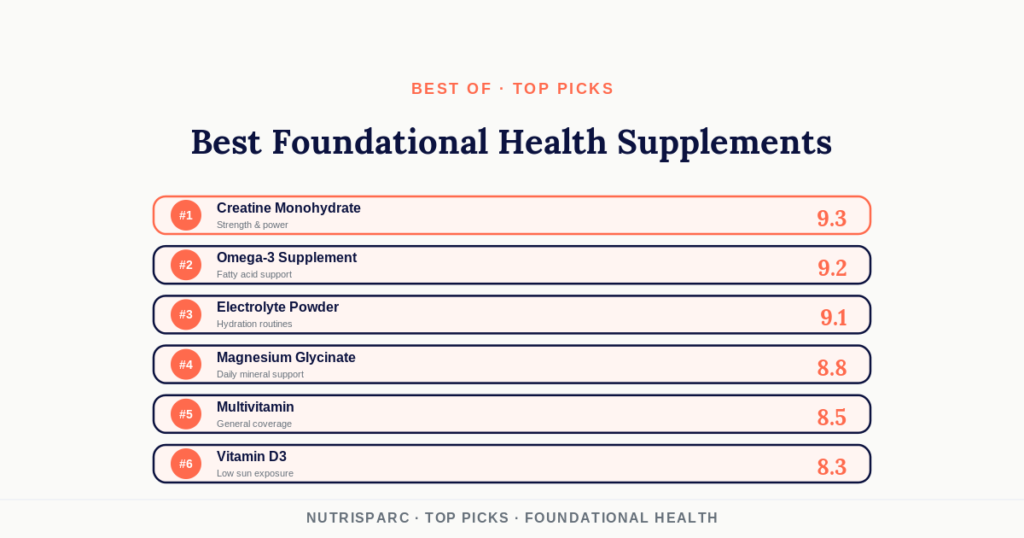
We compared the most practical foundational supplement categories to identify the best foundational health supplements for everyday routines — without relying on aggressive marketing claims, proprietary blends, or unnecessary mega-dosing. Every category was evaluated using our published six-criteria methodology: ingredient quality, dosage transparency, safety profile, third-party testing, value for money, and overall fit.
Below are our six picks of the best foundational health supplements across six user fits: strength and power, fatty acid coverage, hydration routines, daily mineral support, general coverage, and low sun exposure. Ranked by overall score.
| Rank | Product | Score | Best For | Review |
|---|---|---|---|---|
| #1 | Creatine Monohydrate | 9.3 | Best for strength and power | Read Review |
| #2 | Omega-3 Supplement | 9.2 | Best for fatty acid support | Read Review |
| #3 | Electrolyte Powder | 9.1 | Best for hydration routines | Read Review |
| #4 | Magnesium Glycinate | 8.8 | Best for daily mineral support | Read Review |
| #5 | Multivitamin | 8.5 | Best for general coverage | Read Review |
| #6 | Vitamin D3 | 8.3 | Best for low sun exposure | Read Review |
Creatine Monohydrate
Creatine monohydrate is one of the most-studied additions to the best foundational health supplements, supporting strength, power output, and training capacity. According to Examine.com, monohydrate is the best-evidenced and most cost-effective form, typically taken at 3–5 g per day. Look for plain creatine monohydrate, no proprietary blends, and ideally third-party testing such as NSF Certified for Sport.
Omega-3 Supplement
Omega-3 supplements earn a spot among the best foundational health supplements by addressing a common dietary gap for people who do not regularly eat fatty fish. The NIH ODS notes that EPA and DHA support normal cardiovascular and brain function. The most important label detail is the actual EPA and DHA amounts per serving, not the total fish oil weight, and the triglyceride form is generally better absorbed than ethyl ester.
Electrolyte Powder
Electrolyte powders are practical for people who sweat heavily, train in warm climates, follow low-carbohydrate diets, or travel often. A good formula clearly discloses sodium, potassium, and magnesium per serving and matches sugar content to the use case — sugar-free for daily use, carbohydrate-containing for endurance over 60–90 minutes. Among the best foundational health supplements, electrolytes are the most situation-dependent: heavy sweaters benefit clearly, while sedentary users with balanced diets usually meet needs through food.
Magnesium Glycinate
Magnesium glycinate is the most practical starting point among the best foundational health supplements because it is broadly relevant across daily wellness, sleep routines, calm support, and muscle function. According to the U.S. National Institutes of Health Office of Dietary Supplements, magnesium is essential for over 300 enzymatic reactions in the body — and the glycinate form is widely chosen for its gentle, well-tolerated profile compared to citrate or oxide forms. Best for adults who want a transparent, daily mineral supplement without digestive disruption.
Multivitamin
A daily multivitamin earns a place among the best foundational health supplements as nutritional insurance when diet is inconsistent — not as a cure-all. The NIH ODS notes multivitamins can help fill common gaps, with the clearest benefit for people on limited or restricted diets. The most useful formulas are transparent about forms and amounts, use well-absorbed nutrient forms, and avoid mega-dosing. Our recommended pick is a transparency-first, gap-filling formula rather than an everything-in-one megadose.
Vitamin D3
Vitamin D3 (cholecalciferol) is a defensible foundational supplement because deficiency is common, especially with limited sun exposure, and D3 is the form the body uses most readily. The NIH ODS notes vitamin D supports bone health and normal immune function. The key label details are the IU/mcg strength and a meal-friendly oil-based softgel — and because excess vitamin D accumulates, dosing is best guided by bloodwork. Our recommended pick is a USP-verified option at a mainstream maintenance dose.
How We Chose the Best Foundational Health Supplements
Every category in this ranking of the best foundational health supplements was evaluated using our six-criteria methodology: ingredient quality, dosage transparency, safety profile, third-party testing, value for money, and overall fit. No category is included based on commercial considerations — our scores are assigned independently using the same framework applied across the NutriSparc supplement library.
We deliberately focused on practical foundational supplement categories that address real nutritional or lifestyle gaps — magnesium for broad mineral support, omega-3 for fatty acid coverage when fatty fish intake is low, vitamin D3 for limited sun exposure, electrolytes for high sweat-loss situations, and multivitamins for inconsistent diets. A list of best foundational health supplements dominated by megadosed products or trendy proprietary blends would mislead readers about what actually matters in foundational supplementation: real need, transparent labels, reasonable dosing, and evidence-based benefits.
What this list isn’t
This isn’t a roundup of every foundational supplement on the market. Our six picks of the best foundational health supplements reflect six distinct user fits — strength and power, fatty acid coverage, hydration routines, daily mineral support, general coverage, and low sun exposure. If you suspect a specific nutrient deficiency, bloodwork with a clinician should come before supplementation. Common gaps like iron deficiency, low vitamin D, B12 deficiency, or thyroid issues need to be identified and addressed individually rather than masked by broad supplementation. The best foundational health supplements work alongside good diet, sleep, and movement habits, not as a replacement for them.
Good Signs
- Clear ingredient forms and amounts
- No hidden proprietary blends
- Reasonable dosing
- Third-party testing when available
- Specific use case instead of broad miracle claims
- Extreme doses without context
- “Cure,” “detox,” or guaranteed-result language
- No label transparency
- Unclear source or form
- Too much overlap with other supplements
Who Should Be Careful?
Foundational supplements can still have risks. People who are pregnant, nursing, taking medication, managing kidney disease, using blood thinners, or already taking multiple supplements should speak with a qualified healthcare professional before starting a new product.
Final Verdict
For most people, the smartest foundational supplement routine is not the biggest stack. It is a small, intentional setup based on actual needs, transparent labels, reasonable dosing, and quality documentation.
Thorne Creatine posts the highest score in our lineup (9.3), but for most people magnesium remains the most broadly useful starting point because it is practical, widely relevant, and easy to compare when labels are transparent. Omega-3, electrolytes, a multivitamin, and vitamin D3 can also be useful, but the right choice depends on the individual.
Compare the Options Head-to-Head
Still deciding between two foundational picks? These side-by-side comparisons break down dosing, form, third-party testing, and who each option suits best:
- Magnesium Glycinate vs Multivitamin — Which foundational pick deserves your first slot.
- Performance Lab Energy vs Pureboost Clean Energy — Two everyday energy picks compared on formula and value.
- Seed DS-01 vs Ritual Synbiotic+ — Two foundational gut-health options head to head.
What are the best foundational health supplements overall?
By score, Thorne Creatine leads our lineup (9.3/10), with Nordic Naturals omega-3 (9.2) and LMNT electrolytes (9.1) close behind. For most people, though, magnesium glycinate (8.8) is the most broadly useful starting point, with a multivitamin (8.5) and vitamin D3 (8.3) rounding out the six. The best choice depends on your diet, training, and goals.
What foundational supplement should I start with?
The right starting supplement depends on your diet, lifestyle, lab work, and goals — not on a universal “best” choice. Magnesium is one of the most broadly applicable starting points because it supports many normal body functions. For users with limited sun exposure, Vitamin D3 may be a more relevant first supplement. For users who rarely eat fatty fish, Omega-3 can address a common dietary gap. A qualified healthcare professional can help you prioritize based on individual context.
Are foundational health supplements necessary for everyone?
No. Foundational supplements are useful when they address a real nutritional gap, lifestyle factor, or lab-confirmed status — not as universal “insurance” for all adults. Well-nourished individuals with balanced diets and sufficient sun exposure may see limited additional benefit from broad supplementation. The smartest foundational routine is small, intentional, and matched to actual need.
Can I take multiple foundational health supplements together?
Sometimes, but overlap matters significantly. Multivitamins, mineral blends, and immune formulas often contain the same nutrients found in single-ingredient products — leading to accidental stacking at doses higher than needed. Always check total daily intake of vitamin D, magnesium, zinc, iron, and B vitamins across all supplements before adding new products. People taking medication or managing a medical condition should consult a qualified healthcare professional.
Sources
- National Institutes of Health, Office of Dietary Supplements — Magnesium fact sheet for Health Professionals.
- National Institutes of Health, Office of Dietary Supplements — Vitamin D fact sheet for Health Professionals.
- National Institutes of Health, Office of Dietary Supplements — Omega-3 Fatty Acids fact sheet for Health Professionals.
- Manson J.E. et al. (2019). Vitamin and Mineral Supplements: What Clinicians Need to Know. JAMA 314(8):1067–1077 — clinical guidance review on supplementation.
- Examine.com — Multivitamins reference page.