
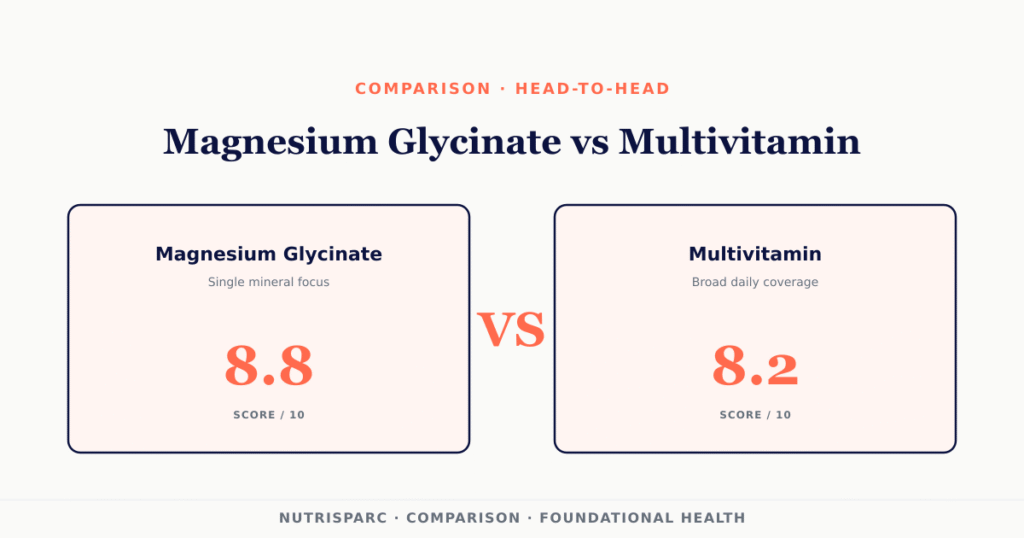
What’s the difference between Magnesium Glycinate and Multivitamin?
Magnesium Glycinate vs Multivitamin is the foundational supplement decision most adults face — and it’s not really a head-to-head matchup so much as two completely different supplement philosophies. Magnesium Glycinate is a single, well-studied mineral in a highly bioavailable chelated form, targeting a specific nutrient where most adults run low. Multivitamin is broad-spectrum daily insurance, providing modest doses across 15-25 vitamins and minerals to fill potential gaps in an imperfect diet.
Both have legitimate use cases, both can support general health, but they answer fundamentally different questions. The Magnesium Glycinate vs Multivitamin choice usually comes down to targeted correction (Magnesium) versus broad insurance (Multivitamin). For broader context, see our six-criteria methodology and the Best Foundational Health Supplements Best Of for category-wide picks.
Ingredient breakdown: Magnesium Glycinate vs Multivitamin
The ingredient profiles tell two completely different stories. Magnesium Glycinate is a single chelated compound — magnesium bound to two glycine molecules — providing 200-400mg of elemental magnesium per serving across reputable brands. The glycinate form is the gold standard for bioavailability and tolerability: it doesn’t produce the laxative effect of magnesium oxide, and it doesn’t compete with other minerals for absorption. The NIH Office of Dietary Supplements notes that approximately 48% of U.S. adults consume less than the EAR for magnesium — making targeted supplementation genuinely useful for many.
Multivitamin takes the opposite approach: broad coverage at modest doses. A quality multivitamin will contain 15-25 vitamins and minerals, typically at 50-100% of the Daily Value for most nutrients. The trade-off is real: doses are individually small (a typical multivitamin provides 50-100mg of magnesium vs 200-400mg in a dedicated supplement), so a multi won’t correct a meaningful deficiency in any single nutrient — but it does provide insurance against multiple shortfall risks simultaneously. Quality varies enormously: cheap multis use poorly absorbed forms (oxide instead of glycinate, cyanocobalamin instead of methylcobalamin), while quality multis use bioavailable forms throughout.
The Magnesium Glycinate vs Multivitamin ingredient gap, in short, is depth (Magnesium Glycinate) versus breadth (Multivitamin). If you have a confirmed or suspected magnesium gap — which is common — Magnesium Glycinate is the more direct route. If your diet is inconsistent across many food groups, a quality Multivitamin provides broader insurance. They’re not actually competitors: many users benefit from taking both, with the Multivitamin as baseline insurance and Magnesium Glycinate as targeted support.
Who should choose Magnesium Glycinate vs Multivitamin?
The Magnesium Glycinate vs Multivitamin decision splits along three dimensions: specific symptoms, dietary consistency, and supplement philosophy.
Choose Magnesium Glycinate if you struggle with sleep onset or quality, you experience muscle cramps or tension, you eat a diet low in leafy greens, nuts, seeds, and whole grains, or you’ve had a blood test confirming low magnesium status. The chelated form is well-tolerated even at higher doses, and the single-target nature makes it easy to assess whether it’s working — most users notice effects within 2-3 weeks. See our full Magnesium Glycinate review for the criterion-by-criterion breakdown.
Choose Multivitamin if your diet varies day-to-day, you follow a restricted diet (vegan, vegetarian, low-carb, elderly with reduced appetite), you want broad insurance without taking 6+ individual supplements, or you have no specific deficiency symptoms but want general nutritional support. The convenience of one daily pill across 15-25 nutrients is meaningful for adherence — most users who try stacking 4-5 single supplements eventually consolidate. Our Multivitamin review covers the full breakdown.
For most adults, the two are actually complementary rather than competing — Multivitamin as broad baseline coverage, Magnesium Glycinate as targeted support for the most common deficiency. Both work synergistically because they don’t overlap in dose: the Multivitamin’s 50-100mg of magnesium plus the Glycinate’s 200-400mg keeps total intake within safe range while ensuring therapeutic dosing. For broader buying guidance, the Foundational Health silo covers the full landscape.
Bottom line: choosing between Magnesium Glycinate vs Multivitamin
The Magnesium Glycinate vs Multivitamin decision is rarely about which product is « better » in absolute terms — both score well on our six-criteria methodology, but they answer different questions. The real question in the Magnesium Glycinate vs Multivitamin choice is which philosophy matches your nutritional reality: targeted correction (Magnesium Glycinate) or broad insurance (Multivitamin).
Pick Magnesium Glycinate if you have specific symptoms aligned with magnesium status (sleep, muscle, stress, cardiovascular), you eat a typical Western diet (which trends low in magnesium), or you want to address one well-evidenced gap before considering broad supplementation. The 200-400mg therapeutic dose can’t be matched by any multivitamin, and the glycinate form is gentle on digestion. Read our full Magnesium Glycinate review for the detailed criterion breakdown.
Pick Multivitamin if you want broad daily insurance against multiple potential shortfalls, you follow a restricted or inconsistent diet, or you prefer one-pill simplicity over a multi-supplement routine. A quality multi covers vitamins A, B-complex, C, D, E, K, plus essential minerals at modest but useful doses. See our Multivitamin review for full context.
Neither supplement is the right fit for diagnosed deficiencies requiring clinical management, pregnancy-specific needs without obstetric guidance, or medical conditions affecting nutrient absorption — those need professional evaluation, not generic supplementation. For broader options across the silo, the Best Foundational Health Supplements Best Of covers other category-leading picks beyond the Magnesium Glycinate vs Multivitamin matchup, and the Foundational Health silo tracks every review and guide we’ve published in this space.
Whichever you choose, the Magnesium Glycinate vs Multivitamin comparison illustrates a recurring theme on NutriSparc: in a category dominated by either expensive proprietary blends or cheap megadoses, both supplements take a more thoughtful approach — targeted, evidence-aligned dosing for Magnesium Glycinate, and broad balanced coverage for a quality Multivitamin. That alone places both above most of what you’ll find on a drugstore shelf, where ingredient choices are often driven by cost rather than bioavailability.
A note on third-party testing in Magnesium Glycinate vs Multivitamin
Quality varies more in the multivitamin category than in the single-mineral category. Reputable Magnesium Glycinate brands (Pure Encapsulations, Thorne, Klaire Labs, NOW Foods) consistently use the actual chelated glycinate form and publish third-party testing. Multivitamin quality, however, ranges from research-grade (Thorne Basic Nutrients, Pure Encapsulations) to bargain-bin formulations using poorly absorbed forms and excessive iron. Our methodology rewards transparency on form selection because the difference between magnesium glycinate and magnesium oxide is the difference between 80% absorption and roughly 4% — and that gap exists across nearly every multivitamin ingredient.
If you have persistent fatigue, muscle issues, or sleep difficulty despite adequate dietary intake and supplementation, that’s a signal to see a clinician for blood work rather than try more supplements. Many nutrient deficiencies can be confirmed with simple tests, and targeted correction at therapeutic doses outperforms broad guessing every time.
Should I take Magnesium Glycinate or Multivitamin first?
If you have specific symptoms aligned with magnesium status (sleep difficulty, muscle cramps, stress), start with Magnesium Glycinate at a therapeutic dose (200-400mg elemental magnesium). If you have no specific symptoms but want general nutritional insurance, start with a quality Multivitamin. For users with both inconsistent diet and specific symptoms, the two are complementary — Multivitamin as baseline plus Magnesium Glycinate as targeted support.
Can I take Magnesium Glycinate and Multivitamin together?
Yes, and they’re often complementary rather than redundant. A typical Multivitamin contains 50-100mg of magnesium — well below therapeutic dosing. Adding 200-400mg of Magnesium Glycinate keeps total intake within safe range (the Upper Limit for supplemental magnesium is 350mg from supplements, beyond food sources) while ensuring meaningful magnesium dose. Take the Multivitamin in the morning with food and the Magnesium Glycinate in the evening before bed for optimal absorption and sleep benefits.
Which is more important: Magnesium Glycinate or Multivitamin?
Neither is universally « more important » — it depends on your diet and symptoms. For the average U.S. adult, magnesium deficiency is more common and more often symptomatic than other micronutrient gaps, which makes Magnesium Glycinate the higher-impact starting point for many. But for users following restricted diets (vegan, low-carb, elderly), a Multivitamin addresses multiple potential gaps at once. The question isn’t « which is more important » but « which gap is most likely in your specific case ».
Which is better value: Magnesium Glycinate or Multivitamin?
On strict cost-per-serving, quality Magnesium Glycinate runs $0.25-0.50/day, while quality Multivitamins range from $0.30-1.00/day. Magnesium Glycinate provides therapeutic dosing of one nutrient; a Multivitamin provides modest dosing of 15-25 nutrients. Per nutrient covered, Multivitamin is cheaper; per therapeutic effect, Magnesium Glycinate is cheaper. Both publish full ingredient transparency across reputable brands, making them strong value choices in their respective categories.
Sources
- National Institutes of Health, Office of Dietary Supplements — Magnesium Health Professional Fact Sheet.
- National Institutes of Health, Office of Dietary Supplements — Multivitamin/mineral Supplements Fact Sheet.
- Walker A.F. et al. (2003). Mg citrate found more bioavailable than other Mg preparations in a randomised, double-blind study. Magnesium Research — magnesium form bioavailability comparison.
- Schwingshackl L. et al. (2017). Dietary supplements and risk of cause-specific death, cardiovascular disease, and cancer: a protocol for a systematic review and network meta-analysis of primary prevention trials. Systematic Reviews — multivitamin clinical outcomes evidence base.
- Boyle N.B. et al. (2017). The Effects of Magnesium Supplementation on Subjective Anxiety and Stress — A Systematic Review. Nutrients — magnesium for stress and sleep.
- Examine.com — Magnesium reference page.