
Learning how to choose an energy supplement is harder than it should be. The market is dominated by caffeine, but caffeine treats the symptom, not the cause. Energy fatigue can stem from sleep debt, micronutrient deficiency, mitochondrial wear, hormonal shifts, or simply a lifestyle that out-runs recovery. The U.S. National Institutes of Health Office of Dietary Supplements notes that B12 deficiency alone is responsible for fatigue in a meaningful share of otherwise healthy adults.
This NutriSparc guide synthesizes our 4 in-depth Energy silo reviews, a 6-criteria evaluation framework, and tier-1 evidence on CoQ10, PQQ, Acetyl-L-Carnitine, citrulline malate, and B vitamins. It helps you match the right category of energy supplement to your specific fatigue driver, rather than defaulting to another caffeine product.
“Energy supplement” is a broad category. The right product depends on your goal: acute alertness, sustained daily energy, training performance, or correction of an underlying micronutrient gap. This guide explains how to evaluate energy supplements without falling for marketing hype.
- Caffeine masks fatigue by blocking adenosine — it does not address root causes and carries tolerance and dependency risks.
- Mitochondrial support (CoQ10, PQQ, ALCAR) builds energy capacity over 2-4 weeks and is the most sustainable category.
- Micronutrient correction (B12, iron, vitamin D) resolves fatigue when a deficiency is the actual driver.
- Pre-workout and daily energy products serve different goals and should not be used interchangeably.
- Proprietary blends, undisclosed doses, and 400+ mg caffeine per serving are red flags worth walking away from.
- Energy supplements do not replace sleep, recovery, or clinical evaluation when fatigue is persistent.
What Are Energy Supplements?
Energy supplements are products designed to support alertness, physical output, mental focus, or cellular ATP production. Unlike prescription stimulants, they are regulated as dietary supplements under DSHEA, which means manufacturers can make broad structure-function claims without proving clinical effect. This regulatory looseness is exactly why label scrutiny matters in this category.
Importantly, energy supplements do not all work the same way. Caffeine blocks adenosine receptors. CoQ10 supports the mitochondrial electron transport chain. ALCAR shuttles fatty acids into mitochondria. B vitamins act as cofactors in ATP-generating enzymatic reactions. A product that “boosts energy” can mean very different things depending on which mechanism it actually targets.
How to Choose an Energy Supplement: A 6-Criteria Framework
When evaluating your options, our framework evaluates every product on six dimensions — the same criteria we apply across our Energy silo reviews. Each criterion is scored independently, then weighted into a composite out of 10.
- Ingredient Quality — Bioavailable forms (ubiquinol vs ubiquinone, methylcobalamin vs cyanocobalamin, Acetyl-L-Carnitine vs L-Carnitine), standardized extracts, no proprietary blends.
- Dosage Transparency — Exact mg per serving disclosed, matched to studied dose ranges (citrulline malate 6-8 g, PQQ 10-20 mg, CoQ10 100-200 mg).
- Safety Profile — Caffeine ceiling clearly stated, cardiovascular interactions documented, anxiety and sleep impact addressed.
- Testing & Transparency — Third-party testing (NSF, Informed Sport, USP), GMP manufacturing, Certificate of Analysis available on request.
- Value for Money — Cost per studied dose, not cost per scoop or per “complex”.
- Overall Fit — Does the product match a real, evidence-based energy goal (acute alertness, sustained capacity, training performance, micronutrient correction)?
For the full scoring methodology, see our scoring methodology page. This framework is the backbone of choosing well in a category where stimulant marketing rarely aligns with sustainable physiology.
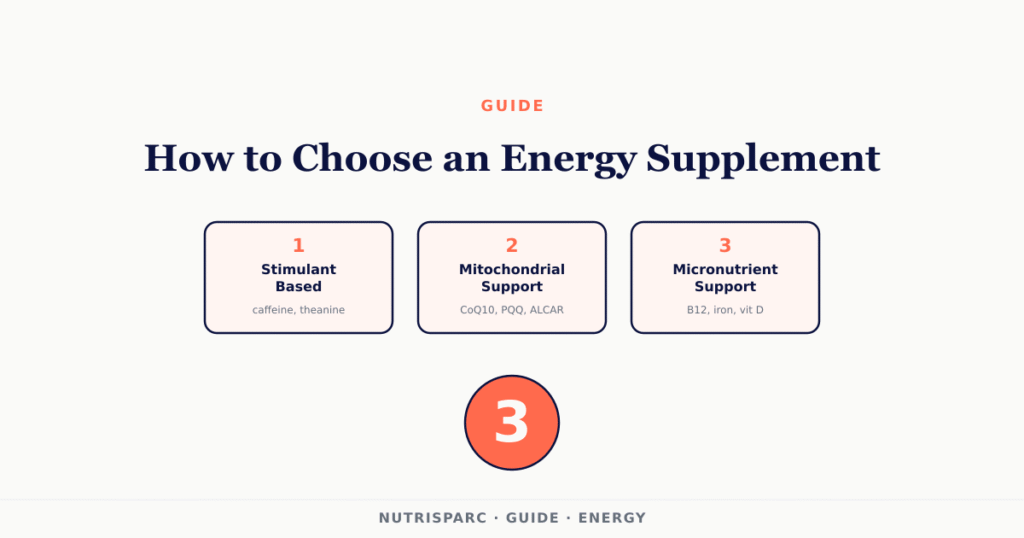
The 3 Categories of Energy Supplements
When comparing options, categories help organize the decision. Not every product belongs in your daily stack — some are situational, some are foundational, and some only make sense if a deficiency is driving your fatigue.
1. Stimulant-Based Energy
Caffeine and related stimulants work by blocking adenosine receptors, which signal tiredness to the brain. The effect is temporary alertness and reduced perception of fatigue. Stimulants are effective for acute situational use — a long drive, a deadline, a training session — but they do not address underlying fatigue and carry tolerance and dependency risks with regular high-dose use.
The practical ceiling for healthy adults sits around 200-300 mg caffeine per single dose and 400 mg per day, per multiple regulatory bodies. Products marketing 300+ mg per serving deserve scrutiny, especially when combined with other stimulants.
2. Mitochondrial Energy Support
Mitochondrial supplements target the cellular machinery that produces ATP, the body’s primary energy currency. Ingredients like CoQ10, PQQ, and Acetyl-L-Carnitine fall into this category. Results build over 2-4 weeks, not 20 minutes, and are more sustainable for long-term energy capacity without dependency.
This category is where the focus shifts from acute symptom management to actual physiological capacity-building. The trade-off is patience: mitochondrial support is invisible week one and meaningful by week three.
3. Micronutrient Energy Support
B12 deficiency, vitamin D deficiency, and iron deficiency are among the most common nutritional drivers of fatigue. Micronutrient-based energy support addresses these gaps directly, which is highly effective when a documented deficiency is actually the cause. It is much less useful when fatigue is rooted in sleep debt or lifestyle.
A blood panel from a healthcare provider is the fastest path to knowing whether this category applies to you. Supplementing without testing is a guess.
The 5 Ingredients That Actually Matter
When comparing options, five ingredient families consistently appear in evidence-supported products. The doses and forms below are where clinical effect has actually been demonstrated.
1. Caffeine (Done Right)
Caffeine is the most-studied energy ingredient in the world. The evidence supports 100-200 mg for cognitive alertness and 3-6 mg/kg before exercise for performance benefit. Combined with 100-200 mg L-theanine, the alertness comes without much of the jitter. Caffeine anhydrous and natural caffeine from green tea or guarana perform similarly at matched doses.
The product itself matters less than the total daily caffeine load, the time of last intake (ideally before 2 pm), and whether the user has a sleep deficit the caffeine is masking.
👉 Read our full Pureboost Clean Energy Review (moderate caffeine + B vitamins + electrolyte format)
2. CoQ10 / Ubiquinol
CoQ10 is essential to mitochondrial electron transport and ATP production. Natural levels decline with age and on statin therapy. The NIH ODS CoQ10 fact sheet notes bioavailability differences between forms. Ubiquinol (reduced form) and enhanced-bioavailability versions like MicroActive Q10 outperform standard ubiquinone in plasma uptake studies.
Studied doses sit in the 100-200 mg range for general support, higher for cardiovascular or statin-related indications. Higher doses without clinical reason do not appear to deliver proportional benefit.
👉 Read our full Performance Lab Energy Review (MicroActive Q10 + PQQ + ALCAR mitochondrial stack)
3. PQQ (Pyrroloquinoline Quinone)
PQQ stimulates mitochondrial biogenesis — the creation of new mitochondria. More mitochondria means greater cellular ATP production capacity. The compound is one of the genuinely novel additions to the mitochondrial category in the last decade. Studied doses sit at 10-20 mg daily.
PQQ stacks naturally with CoQ10 — biogenesis plus existing-mitochondria support — which is why most quality mitochondrial formulas include both.
4. Acetyl-L-Carnitine (ALCAR)
ALCAR transports long-chain fatty acids into mitochondria for oxidation into ATP. The acetyl form crosses the blood-brain barrier better than plain L-Carnitine, giving it utility for cognitive fatigue as well as physical. Carvajal-Larenas 2016 meta-analysis found modest but consistent fatigue improvements at 1-2 g daily.
ALCAR is one of the most-studied ingredients for chronic fatigue contexts and is reasonable as a 4-8 week trial. It is not a stimulant — there is no acute alertness effect.
5. Citrulline Malate
The primary pump and endurance ingredient in stimulant-free pre-workouts. At 6-8 g, Pérez-Guisado 2010 showed meaningful improvements in training volume, perceived exertion, and post-workout recovery. Below 6 g, the dose is generally considered subclinical for performance use.
Knowing what to prioritize for training contexts means looking at the citrulline dose more than the proprietary “pre-workout matrix” branding.
👉 Read our full Transparent Labs Stim-Free Review (8 g citrulline malate + beta-alanine + betaine, fully disclosed doses)
With these five ingredient families covered, the decision shifts from chasing the strongest stim to matching the right mechanism to the right fatigue driver.
How to Build Your Energy Routine
There is no universal energy stack. The right choice depends on the goal — and the right answer is often “fix sleep first, then revisit.” Use these three profiles to identify candidates worth discussing with a healthcare provider.
The Acute Alertness Profile
If the goal is a focused work session, a long drive, or a single training day, the approach reduces to caffeine done well. 100-200 mg caffeine plus 100-200 mg L-theanine, taken before 2 pm, with hydration. This is situational, not daily, and works best when sleep debt is not the underlying issue masking itself as a caffeine need.
The Sustained Daily Energy Profile
For ongoing daily capacity, the focus shifts to mitochondrial support. A stack of CoQ10 or ubiquinol (100-200 mg), PQQ (10-20 mg), and ALCAR (1-2 g) is the most evidence-supported daily approach. Effects emerge over 2-4 weeks, not the first dose, which is why most users abandon this category prematurely.
The Pre-Workout Performance Profile
For training-specific energy and output, the right pick means citrulline malate at 6-8 g, beta-alanine at 3-5 g, and optionally moderate caffeine (3-6 mg/kg). Stim-free pre-workouts are appropriate for evening training sessions where caffeine would compromise sleep, or for users with cardiovascular caution.
Top Energy Supplement Picks
Based on our 6-criteria scoring methodology applied across the Energy silo, these are the products that earned a recommended ranking. Users who already know the essentials can short-cut to these vetted picks. Each is reviewed in depth with full score breakdown, ingredient analysis, and four-week testing notes.
Common Energy Supplement Mistakes
Even with a solid grasp of the essentials, these six patterns trip up most buyers — including experienced supplement users.
- Stacking caffeine on chronic sleep debt — No supplement compensates for 5 hours of sleep over the long term. Caffeine masks the deficit without resolving it, and the rebound fatigue gets worse over time.
- Trusting “proprietary blend” pre-workouts — Hidden doses make underdosing easy. A pre-workout listing “Energy Matrix 7,500 mg” without per-ingredient breakdown almost always under-doses citrulline and beta-alanine.
- Treating mitochondrial stacks like stimulants — Expecting a CoQ10 + PQQ + ALCAR product to “kick in” within 30 minutes guarantees abandonment. The category requires 2-4 weeks of consistent use.
- Ignoring B vitamin status — A meaningful percentage of fatigue cases trace to B12 or iron deficiency. Supplementing without testing is fine for prevention, but it is not a substitute for a blood panel when fatigue is persistent.
- Mixing high-dose caffeine with high-dose synephrine or yohimbine — Cardiovascular stress, anxiety spikes, and sleep disruption stack quickly. Once-popular fat-burner combinations are still on shelves and remain a concern.
- Using energy supplements instead of seeing a doctor — Persistent fatigue, unexplained exhaustion, thyroid symptoms, or post-viral fatigue warrant medical evaluation, not a stronger pre-workout.
Who Should Be Careful?
Knowing what matters also means knowing when to pause. Some users should be especially cautious before starting any energy supplement, including:
- People with diagnosed cardiovascular conditions (arrhythmias, uncontrolled hypertension) — high-dose caffeine and stimulants pose real risk
- People with anxiety disorders or panic disorder — caffeine can exacerbate symptoms even at moderate doses
- People with insomnia or fragmented sleep — caffeine half-life of 5-6 hours makes afternoon intake problematic
- People on prescription stimulants (ADHD medication) or MAOIs — interaction and additive cardiovascular load
- People with hyperthyroidism — stimulants compound symptoms
- Pregnant or nursing individuals — caffeine ceilings are lower and many adaptogens lack pregnancy data
- Children and adolescents under 18 — energy supplements are not appropriate; nutrition and sleep are
When in doubt, speak with a qualified healthcare professional before adding a new energy supplement, particularly if you take prescription medication or manage a cardiovascular condition.
Final Verdict
Energy supplements can be useful, but the loudest products in the category are rarely the best ones. Getting this right is mostly about matching the right mechanism to the right driver: caffeine for acute alertness, mitochondrial stacks for sustained capacity, micronutrient correction when a deficiency exists, and citrulline-led pre-workouts for training output.
For most adults, the smartest approach is to fix sleep and nutrition first, then layer in one or two targeted ingredients for a specific goal. The best energy supplements are not the strongest stimulants. They are the ones that match a real physiological need at a transparent, studied dose.
Frequently Asked Questions
How do you choose an energy supplement?
To choose well, start by identifying your goal: acute alertness, sustained daily energy, training output, or micronutrient correction. Apply our 6-criteria framework — Ingredient Quality, Dosage Transparency, Safety Profile, Testing & Transparency, Value, and Overall Fit. Match the mechanism to the goal: caffeine for acute use, CoQ10 plus PQQ plus ALCAR for daily capacity, citrulline malate for training. Always consult a qualified healthcare professional before starting a new supplement.
What is the safest energy supplement?
Stimulant-free mitochondrial formulas with disclosed doses, third-party testing, and no proprietary blends are the safest category for daily use. Performance Lab Energy fits this profile. For users sensitive to caffeine or with cardiovascular caution, the mitochondrial category avoids the heart rate, blood pressure, and sleep impacts of stimulant products entirely. Pre-workouts and high-dose caffeine drinks should be approached more carefully.
Can I take an energy supplement every day?
Daily use is appropriate for mitochondrial support stacks (CoQ10, PQQ, ALCAR) and micronutrient formulas (B12, vitamin D, iron — when indicated). Pre-workouts are best reserved for training days. High-dose caffeine products should be cycled to prevent tolerance buildup. When comparing options, the daily-versus-situational distinction matters more than which product is marketed loudest.
Why am I always tired despite sleeping enough?
Persistent fatigue despite adequate sleep can have many causes — B12 or iron deficiency, vitamin D insufficiency, hypothyroidism, poor mitochondrial function, blood sugar dysregulation, or unrecognized sleep apnea. A blood panel and clinical evaluation are the right starting point before turning to supplements. Energy supplements that target the wrong cause will not resolve fatigue.
Are energy drinks better than energy supplements?
Most energy drinks rely on high-dose caffeine and sugar — neither of which addresses root-cause fatigue. Quality energy supplements use clinically studied ingredients at transparent doses, making them more targeted for specific goals. For acute alertness, a moderate-caffeine supplement with L-theanine is generally a cleaner option than a sugary high-dose drink.
Do energy supplements actually work?
Yes, in specific contexts. Caffeine produces reliable acute alertness and exercise performance benefit. Mitochondrial stacks (CoQ10, PQQ, ALCAR) show modest but consistent fatigue improvement over 4-8 weeks. Micronutrient correction resolves fatigue when deficiency is the driver. Generic “energy boosters” with proprietary blends and no studied-dose disclosure rarely reproduce these effects. These questions guide a responsible choice: what is the goal, what mechanism fits, and at what dose did the studies show effect.
Sources
The tier-1 references below informed our framework and the ingredient selection, dose ranges, and cautions discussed throughout this guide.
- National Institutes of Health, Office of Dietary Supplements — Vitamin B12 consumer fact sheet.
- National Institutes of Health, Office of Dietary Supplements — Coenzyme Q10 health professional fact sheet.
- Hernandez-Camacho J.D. et al. (2018). Coenzyme Q10 supplementation in aging and disease. Frontiers in Physiology 9:44.
- Jensen R.J. et al. (2014). Pyrroloquinoline quinone stimulates mitochondrial biogenesis through cAMP response element-binding protein phosphorylation. Acta Pharmacologica Sinica 35(7):861–873.
- Carvajal-Larenas F.E. et al. (2016). Acetyl-L-carnitine in the treatment of chronic fatigue: a meta-analysis of randomized controlled trials. Molecular Aspects of Medicine 47-48:18–25.
- Pérez-Guisado J., Jakeman P.M. (2010). Citrulline malate enhances athletic anaerobic performance and relieves muscle soreness. Journal of Strength and Conditioning Research 24(5):1215–1222.
- European Food Safety Authority (EFSA) — Scientific Opinion on the safety of caffeine. EFSA Journal 13(5):4102 (2015), establishing safe intake thresholds of 200 mg single dose and 400 mg daily for healthy adults.
- Examine.com — independent supplement research database (caffeine, CoQ10, PQQ, ALCAR, citrulline reference pages).