
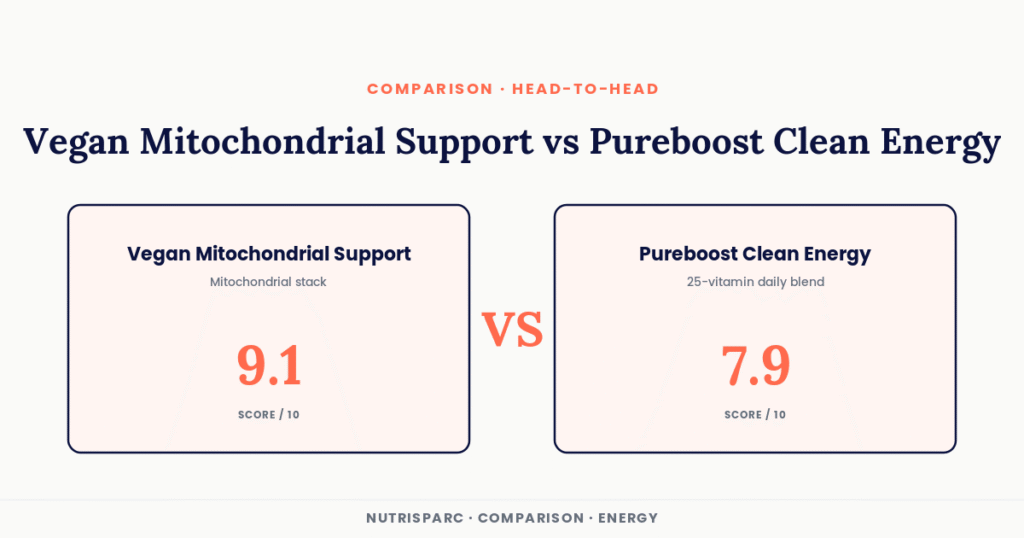
Vegan Mitochondrial Support vs Pureboost Clean Energy compares our #1 energy pick — a premium, stimulant-free mitochondrial formula — against the best budget option in our ranking, a clean 25-vitamin daily blend. Both are caffeine-free, but they target energy in completely different ways. This breakdown is based on our individual hands-on reviews of each product.
| Criterion | Vegan Mitochondrial Support | Pureboost Clean Energy |
|---|---|---|
| Our score | 9.1 / 10 | 7.9 / 10 |
| Format | Plant-based capsules | Stick packs (mix with water) |
| Mechanism | Mitochondrial support | Micronutrient (vitamin) support |
| Key ingredients | CoQ10, PQQ, ALCAR + alpha-lipoic acid, BioPerine | 25 vitamins & minerals (B-complex, C, D, zinc) |
| Caffeine | None | None |
| Onset | Builds over 2–3 weeks | Mild, ongoing daily support |
| Availability | Amazon (Fulfilled by Amazon) | pureboost.com + Amazon |
| Price | Moderate | Most affordable |
| Best for | Sustained crash-free energy optimization | Clean daily micronutrient top-up |
Formula and how each one works
Vegan Mitochondrial Support targets the root cause of fatigue rather than masking it: CoQ10, PQQ and ALCAR support mitochondrial ATP production, mitochondrial biogenesis, and fatty-acid transport respectively. In our Vegan Mitochondrial Support review, sustained afternoon energy, better endurance and clearer cognition emerged from around week three — cumulative rather than immediate.
Pureboost Clean Energy works through micronutrient sufficiency: a 25-vitamin and mineral blend (B-complex, vitamin C, vitamin D, zinc) that supports the body’s natural energy metabolism. In our Pureboost Clean Energy review, effects were mild but consistent — most noticeable in users who were previously low in B vitamins or vitamin D — and it functions best as a daily top-up rather than an acute boost.
Which approach fits your goal?
Vegan Mitochondrial Support is for users who want long-term, crash-free energy optimization and are willing to be patient (and pay a premium) for compounding benefits. Pureboost is for users who want a clean, affordable daily micronutrient drink that gently supports energy — neither product relies on stimulants, so both stack safely with coffee or a pre-workout.
Availability and value
Pureboost wins on price — it is the most affordable option in our ranking and available on Amazon and direct. Vegan Mitochondrial Support is moderately priced and also available on Amazon with fast Prime shipping. Neither contains caffeine, so both can be taken later in the day without disrupting sleep.
Bottom line: which one should you choose?
Choose Vegan Mitochondrial Support if you want serious, sustained, stimulant-free energy that builds over weeks and addresses fatigue at the cellular level. It is our #1 energy pick at 9.1/10.
Choose Pureboost Clean Energy if you want a clean, affordable daily vitamin drink for gentle everyday energy support, especially if your diet may be low in B vitamins or vitamin D. It is our best budget pick at 7.9/10.
When we weighed Vegan Mitochondrial Support vs Pureboost Clean Energy, the key difference was mechanism: Vegan Mitochondrial Support targets mitochondrial output with CoQ10, PQQ and acetyl-L-carnitine, while Pureboost leans on a clean 25-vitamin and electrolyte blend for a lighter daily lift. The Vegan Mitochondrial Support vs Pureboost Clean Energy verdict depends on your goal — choose Vegan Mitochondrial Support for deep, stimulant-free cellular energy support, or Pureboost for an affordable, refreshing everyday boost.
How we scored this Vegan Mitochondrial Support vs Pureboost matchup
Our Vegan Mitochondrial Support vs Pureboost verdict rewards the formula that fits how you actually use an energy supplement. We compared the mechanism behind each product, the quality and dosing of the active ingredients, whether they rely on stimulants, and the true cost per serving. Vegan Mitochondrial Support takes a stimulant-free, mitochondrial approach with ingredients like Acetyl-L-Carnitine and CoQ10 aimed at sustained cellular energy, while Pureboost delivers a fast, caffeine-and-vitamin hit at a noticeably lower price.
If you want the one-line takeaway from this Vegan Mitochondrial Support vs Pureboost comparison: choose Vegan Mitochondrial Support for smooth, jitter-free stamina without caffeine, and choose Pureboost when you want an affordable, flavored energy and hydration boost with a quick caffeine kick before a workout.
Stimulant-free vs caffeine: the core trade-off
The deciding factor in this Vegan Mitochondrial Support vs Pureboost comparison is how each product creates energy. Vegan Mitochondrial Support is built around mitochondrial support — ingredients like Acetyl-L-Carnitine, R-Lipoic Acid, CoQ10 and a bioactive form of PQQ are intended to help your cells produce ATP more efficiently, giving steady stamina without a stimulant crash. Because it contains no caffeine, it suits people who are sensitive to stimulants or who want energy support late in the day without affecting sleep.
Pureboost works the familiar way: a measured dose of caffeine plus B-vitamins, antioxidants and electrolytes mixed into a flavored drink for a quick, refreshing lift. It is cheaper, faster-acting, and doubles as hydration, but the energy is shorter-lived and stimulant-based. So the honest Vegan Mitochondrial Support vs Pureboost verdict depends on whether you want sustained, jitter-free output or an immediate, affordable boost before a workout.
Frequently asked questions
Do either of them contain caffeine?
No. Both Vegan Mitochondrial Support and Pureboost Clean Energy are completely caffeine-free, so both can be taken later in the day and stacked with coffee or a pre-workout.
Which works faster?
Neither is an instant stimulant. Pureboost offers mild, ongoing daily support; Vegan Mitochondrial Support builds cumulatively over 2–3 weeks of consistent use. If you need an immediate boost, you would pair either one with a separate stimulant.
Which is better value?
Pureboost is the most affordable option in our ranking and the better value for everyday micronutrient support. Vegan Mitochondrial Support costs more but targets mitochondrial energy production for users focused on long-term optimization.
Sources
- NIH Office of Dietary Supplements — Dietary Supplements for Exercise and Athletic Performance: Fact Sheet for Health Professionals.
- Examine.com — Coenzyme Q10: research summary.