
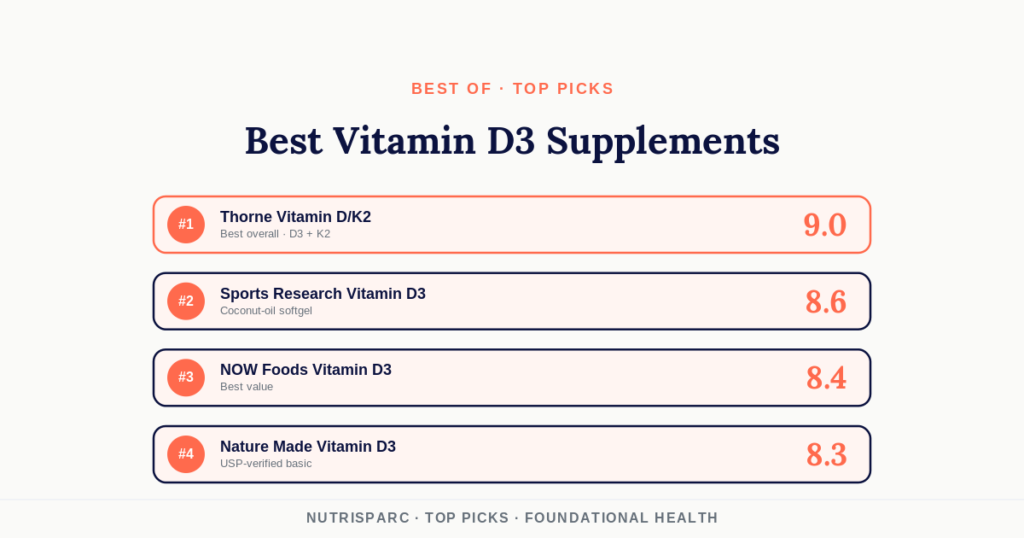
Vitamin D3 (cholecalciferol) is one of the more defensible foundational supplements: deficiency is common, especially with limited sun exposure, and D3 is the form the body uses most readily. We compared the D3 products we have reviewed on our six-criteria methodology. Below are our four picks of the best vitamin D3 supplements, ranked by overall score.
| Rank | Product | Score | Best For | Review | Buy |
|---|---|---|---|---|---|
| #1 | Thorne Vitamin D/K2 | 9.0 | Best overall (D3 + K2) | Read Review | Direct only |
| #2 | Sports Research Vitamin D3 | 8.6 | Best coconut-oil softgel | Read Review | Check Price → |
| #3 | NOW Foods Vitamin D3 | 8.4 | Best value | Read Review | Check Price → |
| #4 | Nature Made Vitamin D3 | 8.3 | Best USP-verified basic | Read Review | Check Price → |
Thorne Vitamin D/K2
Thorne pairs D3 with K2 (MK-4) in flexible liquid drops, with NSF Certified for Sport status — a rare third-party signal in a category where most D3 products carry none. Premium and liquid rather than a simple softgel, but the best-tested option here.
Sports Research Vitamin D3
Sports Research delivers D3 in an organic coconut-oil carrier that supports absorption, non-GMO and third-party tested. The common 5000 IU strength is high, so match it to your blood levels.
NOW Foods Vitamin D3
NOW is the value play: a plain cholecalciferol softgel at some of the lowest prices in the category, from a respected manufacturer with in-house testing. No consumer-facing seal, but strong value.
Nature Made Vitamin D3
Nature Made is the certified, accessible basic: USP Verified, an oil-based softgel, and a pharmacy price. No frills, but a recognized seal and easy availability make it a dependable everyday D3.
How We Chose the Best Vitamin D3 Supplements
Each product was evaluated on ingredient quality, dosage transparency, safety, third-party testing, value, and overall fit. For vitamin D specifically, the decisive factors are a clear IU/mcg strength, a meal-friendly oil-based or liquid format for absorption, and credible testing — D3 is cheap to make, so certification and transparency separate the field more than the active itself.
Who Should Be Careful?
Vitamin D is fat-soluble and accumulates, so more is not better. People taking high doses, those with conditions affecting calcium (such as hyperparathyroidism or kidney disease), and anyone on interacting medications should let bloodwork and a clinician set the dose. This page is educational, not medical advice.
Final Verdict
Thorne Vitamin D/K2 leads at 9.0/10 for sport-grade certification and the D3/K2 pairing, but for most people a basic certified D3 at the right IU is all they need — Sports Research, NOW, and Nature Made all do that well at lower prices. Pick the strength with bloodwork, and read the broader vitamin D3 evidence overview for who actually benefits.
What is the best vitamin D3 supplement?
By our six-criteria method, Thorne Vitamin D/K2 (9.0/10) leads for its NSF Certified for Sport status and D3/K2 pairing, followed by Sports Research (8.6), NOW Foods (8.4), and Nature Made (8.3). For most people a basic certified D3 at the right IU is sufficient.
How much vitamin D3 should I take?
It depends on your blood levels and sun exposure. Strengths range from 1000 IU to 5000 IU and beyond; let bloodwork and a clinician set your target rather than defaulting to a high dose, since vitamin D accumulates.
Should I take D3 with K2?
Some research links D3 and K2 together to bone and cardiovascular support. The combination (as in Thorne D/K2) is reasonable for many, though not essential for everyone. A standalone D3 is fine if you do not want K2.
Can you take too much vitamin D3?
Yes. Vitamin D is fat-soluble and accumulates, so excessive doses can cause harm over time. This is why dosing is best guided by bloodwork, especially above 2000 IU daily.
Sources
- NIH Office of Dietary Supplements — Vitamin D fact sheet for Health Professionals.
- Examine.com — Vitamin D reference page.