
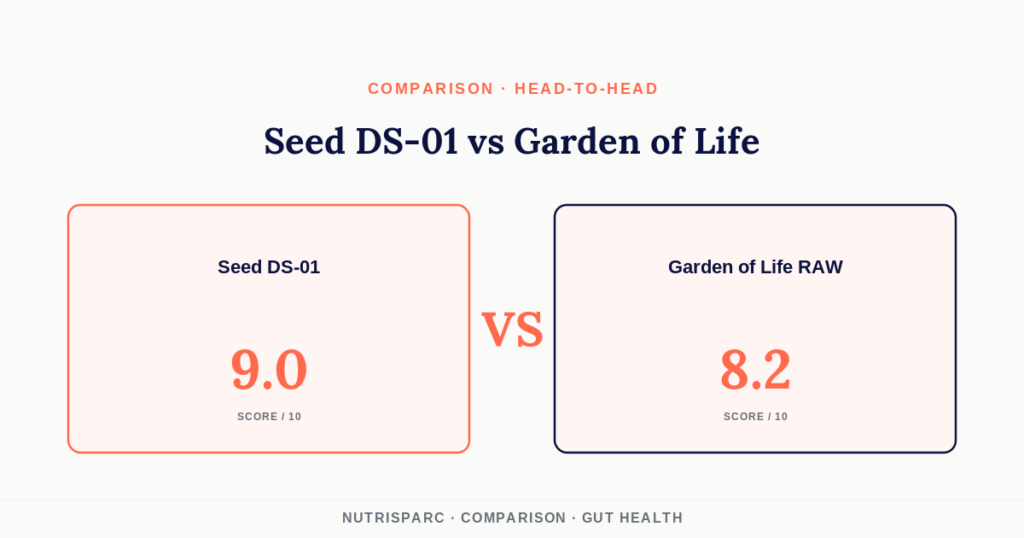
Seed DS-01 and Garden of Life RAW Probiotics take very different routes to gut support: a precision-dosed, heavily documented 24-strain synbiotic versus a high-diversity, whole-food 34-strain formula with added enzymes. In our six-criteria assessment, Seed DS-01 scored 9.0/10 and Garden of Life RAW scored 8.2/10.
This comparison uses the same six-criteria methodology we apply to every product. Strain counts and formulas change — check the current label before buying.
What’s the difference between Seed DS-01 and Garden of Life RAW?
The split is precision versus diversity. Seed DS-01 is a 24-strain synbiotic (probiotic plus prebiotic) delivering 53.6 billion AFU at point of consumption, in a nested ViaCap capsule designed to survive stomach acid, with full public strain documentation. Garden of Life RAW Probiotics offers higher raw diversity — 34 strains in an unprocessed, whole-food formula with digestive enzymes and vitamins — but requires consistent refrigeration, making it less travel-friendly.
Ingredient breakdown: Seed DS-01 vs Garden of Life RAW
Strains and dose. Garden of Life leads on raw count (34 vs 24), but Seed emphasizes documented, studied strains at a defined AFU dose rather than count alone. Delivery. Seed’s ViaCap targets survival through stomach acid; Garden of Life relies on a raw, refrigerated formula. Extras. Garden of Life bundles digestive enzymes and vitamins; Seed adds a prebiotic to make it a synbiotic. Transparency. Seed’s full strain documentation is a standout; Garden of Life carries NSF Certified for Sport.
Who should choose Seed DS-01 vs Garden of Life RAW?
Choose Seed DS-01 if you value documented strains, a defined dose, acid-resistant delivery, and don’t want to refrigerate your probiotic. Choose Garden of Life RAW if you prefer high strain diversity in a whole-food formula with added enzymes, and refrigeration isn’t an obstacle for you.
Who should be careful: people who are immunocompromised, seriously ill, or post-surgery should consult a healthcare professional before taking any probiotic. This comparison is educational — not medical advice.
Bottom line: choosing between Seed DS-01 and Garden of Life RAW
Seed DS-01 wins at 9.0/10 on documentation, defined dosing, and shelf-stable delivery, but Garden of Life RAW at 8.2/10 is a strong choice if you want maximum strain diversity in a whole-food formula and don’t mind refrigerating it. Read the full Seed DS-01 review and Garden of Life review, and see the full best gut health supplements lineup.
A note on strain count vs documentation
More strains is not automatically better. What matters is whether the strains are studied, dosed at meaningful levels, and delivered alive to the gut. Seed emphasizes documented strains and a defined AFU dose; Garden of Life emphasizes raw diversity. Both are valid philosophies — verify strain lists and storage requirements on the current packaging.
Is Seed DS-01 or Garden of Life RAW better?
They prioritize different things. Seed DS-01 is a documented 24-strain synbiotic with a defined dose and acid-resistant, shelf-stable capsule; Garden of Life RAW offers 34 strains in a refrigerated, whole-food formula with enzymes. Choose Seed for documentation and convenience, Garden of Life for raw diversity.
Does more strains mean a better probiotic?
Not necessarily. Strain count is less important than whether the strains are studied, dosed meaningfully, and delivered alive. Garden of Life has more strains (34 vs 24), but Seed emphasizes documented strains at a defined AFU dose.
Does either need refrigeration?
Garden of Life RAW Probiotics requires consistent refrigeration, which makes it less travel-friendly. Seed DS-01 is designed to be shelf-stable with an acid-resistant ViaCap capsule, so it does not need refrigeration.
Which is better for travel?
Seed DS-01, because it is shelf-stable and does not require refrigeration. Garden of Life RAW needs to stay cold, which complicates travel and inconsistent storage.
Sources
- NIH Office of Dietary Supplements — Probiotics: Fact Sheet for Health Professionals.
- NCCIH — Probiotics: What You Need To Know.