
What’s the difference between Seed DS-01 and Ritual Synbiotic+?
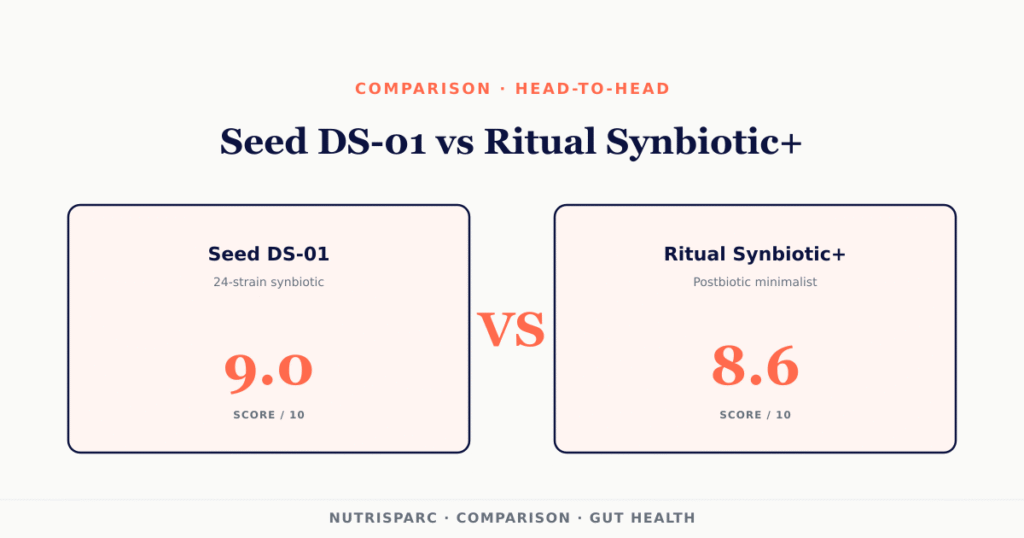
Seed DS-01 vs Ritual Synbiotic+ is a head-to-head between two of the most well-regarded synbiotic probiotics on the market — but they take opposite philosophical approaches. Seed DS-01 is a comprehensive 24-strain synbiotic anchored by Indian Pomegranate prebiotic, delivered in a climate-resistant ViaCap nested capsule. Ritual Synbiotic+ is a minimalist 3-in-1 formula combining two clinically-studied probiotic strains (LGG and BB-12) with Tributyrin as a postbiotic for butyrate signaling.
Both products publish full strain-level transparency, both use delayed-release capsule technology, and both avoid the proprietary-blend tactics common in mass-market probiotics. The Seed DS-01 vs Ritual Synbiotic+ choice usually comes down to strain diversity (Seed) versus evidence-led minimalism (Ritual). For broader context, see our six-criteria methodology and the Best Gut Health Supplements Best Of for category-wide picks.
Ingredient breakdown: Seed DS-01 vs Ritual Synbiotic+
The ingredient profiles tell two completely different stories. Seed DS-01 stacks 24 strains across 4 functional clusters — digestive health, gut barrier integrity, gut immunity, cardiovascular health, and dermatological health. Total dose is 53.6 billion AFU (Active Fluorescent Units, Seed’s preferred metric over CFU). The 12 strains in the prebiotic-paired ferritin compartment include Bifidobacterium longum SD-BB536-JP, Lactobacillus plantarum SD-LP1-IT, and Bifidobacterium breve SD-BR3-IT. The Indian Pomegranate prebiotic provides selective fermentation support for the probiotic strains during transit.
Ritual Synbiotic+ takes the opposite angle: a minimalist 2-strain formula combining Lactobacillus rhamnosus GG (LGG) and Bifidobacterium animalis subsp. lactis (BB-12) — two of the most rigorously studied probiotic strains in clinical literature. The total dose is 11 billion AFU, paired with Tributyrin (CoreBiome) as a postbiotic for direct butyrate signaling. The NIH Office of Dietary Supplements notes that strain identity matters more than total CFU count for clinical outcomes — Ritual’s strain choices are aligned with that principle.
The Seed DS-01 vs Ritual Synbiotic+ ingredient gap, in short, is broad-spectrum diversity (Seed) versus evidence-concentrated simplicity (Ritual). Neither uses proprietary blends, both provide strain-level transparency, but they target different gut health philosophies. If you want maximum strain coverage backed by broad clinical evidence, Seed wins. If you want only the most-studied strains in a minimal stack, Ritual wins.
Who should choose Seed DS-01 vs Ritual Synbiotic+?
The Seed DS-01 vs Ritual Synbiotic+ decision splits along three dimensions: strain philosophy, formulation depth, and value preference.
Choose Seed DS-01 if you want comprehensive 24-strain coverage across digestive, immune, dermatological, and cardiovascular pathways, you value the ViaCap climate-resistant delivery system, or you’re new to probiotics and want broad-spectrum support without needing to research individual strains. The 53.6 billion AFU dose and prebiotic pairing make it a comprehensive daily protocol. See our full Seed DS-01 review for the criterion-by-criterion breakdown.
Choose Ritual Synbiotic+ if you prefer evidence-led minimalism, you’ve already taken broad-spectrum probiotics and want to focus on the most-studied strains, you value the postbiotic component (Tributyrin) for butyrate signaling, or you prefer a 1-capsule daily routine over 2 capsules. The Made Traceable program adds supply chain transparency that Seed doesn’t match. Our Ritual Synbiotic+ review covers the full breakdown.
For users who rotate probiotics over time, the two are actually sequential rather than competing — Seed for foundational broad-spectrum loading, Ritual for targeted maintenance with postbiotic support. Both have full transparency, both use subscription-only delivery to ensure freshness, and both avoid the shelf-stable refrigeration compromises common in retail probiotics. For broader buying guidance, the Gut Health silo covers the full landscape.
Bottom line: choosing between Seed DS-01 vs Ritual Synbiotic+
The Seed DS-01 vs Ritual Synbiotic+ decision is rarely about which product is « better » in absolute terms — both score within half a point of each other on our six-criteria methodology. The real question in the Seed DS-01 vs Ritual Synbiotic+ choice is which philosophy matches your gut health priorities: broad-spectrum coverage (Seed) or evidence-concentrated minimalism (Ritual).
Pick Seed DS-01 if your goal is comprehensive multi-pathway gut support, you want a synbiotic format with built-in prebiotic delivery, or you value strain diversity backed by 4 functional clusters. The ViaCap delivery system protects strains through gastric transit, which solves the survivability problem most probiotics ignore. Read our full Seed DS-01 review for the detailed criterion breakdown.
Pick Ritual Synbiotic+ if you want only the most-studied strains (LGG and BB-12 have hundreds of RCTs combined), you value the postbiotic component for direct butyrate signaling, or you prefer minimalist stacks over comprehensive ones. The Made Traceable program lets you verify every ingredient’s source — a transparency level Seed has yet to publish. See our Ritual Synbiotic+ review for full context.
Neither product is the right fit for diagnosed IBS, IBD, or post-antibiotic recovery requiring clinical guidance — those need professional GI evaluation, not direct-to-consumer probiotics. For broader options across the silo, the Best Gut Health Supplements Best Of covers other category-leading picks beyond the Seed DS-01 vs Ritual Synbiotic+ matchup, and the Gut Health silo tracks every review and guide we’ve published in this space.
Whichever you choose, the Seed DS-01 vs Ritual Synbiotic+ comparison illustrates a recurring theme on NutriSparc: in a category dominated by cheap shelf-stable formulas with vague “10 billion CFU” claims, both products take a more thoughtful approach — either through 24-strain comprehensive coverage (Seed) or through evidence-concentrated strain selection (Ritual). That alone places both above most of what you’ll find on a drugstore shelf.
A note on third-party testing in Seed DS-01 vs Ritual Synbiotic+
Both brands publish third-party testing documentation, which puts them in the top decile of probiotic manufacturers. Seed runs full COA testing on every batch including identity, purity, and viability through expiration date. Ritual’s Made Traceable program publishes ingredient origin documentation publicly, including supplier names and country of origin. Our methodology rewards transparency on testing because probiotic labels alone are unreliable — independent lab audits have repeatedly shown shelf-stable retail probiotics fail to match their CFU claims at point of purchase.
If digestive issues persist for more than three weeks despite probiotic supplementation, that’s a signal to see a gastroenterologist rather than try a different product. Chronic bloating, persistent constipation, or recurring diarrhea can indicate clinical conditions (SIBO, IBS subtypes, food intolerances) that probiotics alone cannot address.
Is Seed DS-01 or Ritual Synbiotic+ better for daily maintenance?
Both Seed DS-01 and Ritual Synbiotic+ are designed for daily maintenance, but they suit different user profiles. Seed DS-01 is better for broad-spectrum maintenance across multiple gut health pathways (digestive, immune, dermatological). Ritual Synbiotic+ is better for users who want minimalist daily support focused on the most-studied strains plus postbiotic signaling. Neither is the « best overall » — they target different gut health philosophies.
Can I take Seed DS-01 and Ritual Synbiotic+ together?
We don’t recommend stacking two synbiotics simultaneously without a clinician’s guidance. The strain overlap between Seed DS-01 and Ritual Synbiotic+ is minimal, but the total probiotic load (65+ billion AFU combined) is well above what most adults need for maintenance. A more practical approach is sequential rotation: 3-6 months on Seed for foundational loading, then transition to Ritual for targeted maintenance.
Do either contain prebiotics or postbiotics?
Seed DS-01 contains a prebiotic (Indian Pomegranate extract) paired with the probiotic strains for selective fermentation support during transit. Ritual Synbiotic+ contains Tributyrin as a postbiotic — a precursor to butyrate, the short-chain fatty acid that supports gut barrier integrity. So they cover different parts of the synbiotic spectrum: Seed pairs probiotic + prebiotic, while Ritual pairs probiotic + postbiotic.
Which is better value: Seed DS-01 or Ritual Synbiotic+?
On cost-per-serving, Ritual Synbiotic+ is slightly more accessible ($35/month vs Seed’s $49.99/month). Seed DS-01 includes more strains and a prebiotic, which justifies the premium for users wanting comprehensive coverage. Ritual’s value sits in the minimalist philosophy and the postbiotic addition. Pure cost favors Ritual; ingredient breadth favors Seed. Both publish full strain transparency and third-party testing, making them strong value choices in their respective categories.
Sources
- National Institutes of Health, Office of Dietary Supplements — Probiotics Consumer Fact Sheet.
- Hill C. et al. (2014). The International Scientific Association for Probiotics and Prebiotics consensus statement on the scope and appropriate use of the term probiotic. Nature Reviews Gastroenterology & Hepatology — definitional gold standard.
- Hempel S. et al. (2012). Probiotics for the prevention and treatment of antibiotic-associated diarrhea: a systematic review and meta-analysis. JAMA — LGG strain efficacy evidence.
- Vinderola G. et al. (2022). The concept of postbiotics. Foods — postbiotic mechanism research base for Tributyrin/butyrate signaling.
- Markowiak P. and Śliżewska K. (2017). Effects of probiotics, prebiotics, and synbiotics on human health. Nutrients — synbiotic concept review.
- Examine.com — Probiotics reference page.