
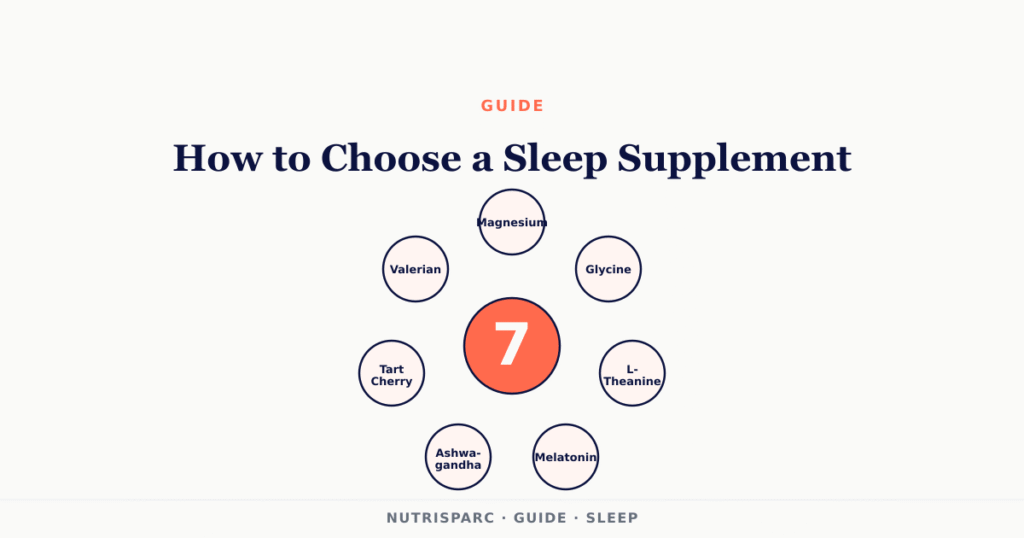
Learning how to choose a sleep supplement matters more than ever — the market is flooded with bold claims, proprietary blends, and 10 mg melatonin gummies marketed as a fix for every sleep problem. Most products are overhyped, underdosed, or both. The U.S. National Institutes of Health Office of Dietary Supplements emphasizes that supplements should fill documented gaps rather than replace foundational sleep behaviours.
This NutriSparc guide synthesizes our 4 in-depth Sleep silo reviews, a 6-criteria evaluation framework, and tier-1 evidence from Sleep Medicine Reviews, the Cochrane Database, and the NIH NCCIH to help you identify which ingredients and products genuinely fit your specific sleep problem — and which to skip.
“Sleep supplement” is a broad category. The right choice depends on which sleep issue you face: onset difficulty, fragmented nights, circadian disruption from travel or shift work, or stress-driven rumination. This guide explains how to evaluate sleep supplements without falling for marketing claims.
- Sleep supplements work best as targeted tools — match the ingredient to the specific sleep problem you are trying to solve.
- Magnesium glycinate, glycine, and low-dose melatonin have the strongest evidence-to-cost ratio for most adults starting out.
- Melatonin is a chronobiotic, not a sedative — lower doses (0.3-1 mg) generally work better than the 5-10 mg US market default.
- Proprietary blends, undisclosed doses, and “sleep in 5 minutes” claims are red flags worth walking away from.
- Sleep supplements do not replace sleep hygiene, cognitive behavioural therapy for insomnia (CBT-I), or medical evaluation for a sleep disorder.
- Persistent insomnia, daytime exhaustion, or witnessed apneas warrant a sleep physician — not a stronger pill.
What Are Sleep Supplements?
Sleep supplements are products designed to support sleep onset, sleep maintenance, sleep quality, or circadian alignment. Unlike prescription hypnotics, they are not regulated for efficacy by the FDA — they fall under DSHEA, which means manufacturers can make general structure-function claims without proving clinical effect. This regulatory gap is precisely why label scrutiny matters so much.
Importantly, sleep supplements do not all work the same way. Magnesium acts on GABA and the parasympathetic nervous system. Melatonin signals circadian phase. L-theanine modulates alpha brain waves. Botanicals like ashwagandha, valerian, and apigenin work through partly distinct pathways. A product that “improves sleep” on a wrist tracker is not necessarily improving the right things — falling asleep faster is not the same thing as sleeping better.
How to Choose a Sleep Supplement: A 6-Criteria Framework
When evaluating your options, our framework evaluates every product on six dimensions — the same criteria we apply across our Sleep silo reviews. Each criterion is scored independently, then weighted into a composite out of 10.
- Ingredient Quality — Bioavailable forms (magnesium glycinate or bisglycinate vs oxide, KSM-66 ashwagandha vs generic root powder), standardized extracts, no proprietary blends.
- Dosage Transparency — Exact mg per serving disclosed, matched to studied dose ranges (e.g., glycine 3 g, L-theanine 200-400 mg, melatonin 0.3-1 mg low-dose).
- Safety Profile — Medication interactions documented, sedating-stack risk addressed, contraindications stated.
- Testing & Transparency — Third-party testing (NSF, USP, Informed Sport), GMP manufacturing, Certificate of Analysis available on request.
- Value for Money — Cost per studied dose, not cost per bottle or per serving of “complex”.
- Overall Fit — Does the supplement match a real, evidence-based sleep problem the user has?
For the full scoring methodology, see our scoring methodology page. This framework is the backbone of choosing well consistently across very different ingredient categories.
Categories of Sleep Supplements
When comparing options, categories help organize the decision. We group supplements by mechanism and evidence quality, not by marketing claims. Each section identifies the studied dose range, the typical form, and where a NutriSparc-reviewed product fits.
1. Magnesium
Magnesium is the most-studied mineral in the sleep space. The mechanism is reasonable: magnesium acts on GABA receptors and modulates the parasympathetic nervous system, both relevant to sleep onset and depth. A 2022 systematic review of randomized trials found modest improvements in sleep onset latency and total sleep time in adults with insomnia symptoms, with the strongest effects in older adults whose dietary intake was already low. Per the NIH ODS, approximately 48% of Americans consume less than the Estimated Average Requirement for magnesium.
Form matters significantly: magnesium glycinate (also called bisglycinate) and L-threonate are the forms most studied for sleep and the gentlest on digestion. Magnesium oxide is poorly absorbed and primarily acts as a laxative. A typical sleep dose is 200 to 400 mg of elemental magnesium, taken 30 to 60 minutes before bed.
👉 Read our full MoonBrew Review (uses magnesium glycinate with reishi and KSM-66 ashwagandha)
2. Glycine
Glycine is an inhibitory neurotransmitter. Two studies from the Yamadera (2007) and Bannai (2012) groups found that 3 g of glycine taken before bed improved subjective sleep quality and shortened sleep onset latency in adults with mild insomnia complaints. The effect is modest but consistent, and glycine has a generally favourable safety profile. It is also inexpensive, which makes the cost-per-studied-dose ratio one of the best in the category.
Glycine is most often sold as an unflavoured powder or capsule. There is no compelling evidence for proprietary “advanced” forms; standard glycine USP at the studied dose is sufficient.
3. L-Theanine
L-theanine is an amino acid found in tea. It does not sedate — it produces a “relaxed alertness” by increasing alpha-wave activity (Hidese 2019 Nutrients). The strongest evidence is for stress-related sleep disturbance and anxiety-driven sleep onset delay, at doses of 200 to 400 mg. It is not a hypnotic, and it will not help you stay asleep — but for racing-mind onset issues, it is a reasonable adjunct with a clean safety profile.
4. Melatonin
Melatonin is widely misunderstood. It is not a sleeping pill — it is a chronobiotic, a hormonal signal that tells your circadian system “night is here.” Used correctly, it can help with circadian disruption: jet lag, shift work, delayed sleep phase. Used incorrectly — high dose, every night, for general insomnia — the evidence is weaker, and the NIH National Center for Complementary and Integrative Health (NCCIH) notes the dose-response curve actually inverts at higher doses.
Lower is better, and timing matters more than dose. Most well-conducted studies (Auld 2017 Sleep Medicine Reviews meta-analysis) use 0.3 to 1 mg taken 3 to 5 hours before desired sleep, not 5 to 10 mg right at bedtime. The high-dose gummies that dominate the US market are a marketing artifact, not a clinical recommendation. For chronic primary insomnia, melatonin has not consistently outperformed placebo in adults; for circadian misalignment, the evidence is much stronger.
👉 Read our full Natrol Sleep & Restore Review (5 mg melatonin format, drugstore staple)
5. Ashwagandha (KSM-66)
KSM-66 ashwagandha is a standardized root extract that has shown improvements in sleep efficiency, onset latency, and perceived stress in several trials, including Langade 2019 Cureus. The mechanism appears to involve cortisol modulation rather than direct sedation. Many of the published trials are industry-funded, which we account for in our scoring. The signal is plausible but not as robust as the marketing claims. Effective doses sit in the 300-600 mg range, taken once or twice daily.
👉 Read our full MoonBrew Review (KSM-66 ashwagandha + reishi + magnesium glycinate stack)
6. Tart Cherry & Apigenin
Tart cherry (Montmorency) contains small amounts of melatonin and anti-inflammatory anthocyanins. Two small studies in older adults showed improved sleep efficiency. The effect is real but modest, and the studied dose (240 ml of concentrated juice, twice daily) is higher than most capsule supplements deliver.
Apigenin, the bioactive in chamomile, has plausible mechanisms — partial benzodiazepine receptor agonism — but human sleep data is limited. It is reasonable to try, especially in tea form, but evidence is preliminary.
👉 Read our full Performance Lab Sleep Review (tart cherry + magnesium bisglycinate + ashwagandha capsule stack)
7. Valerian Root
Valerian has been studied for decades. Meta-analyses, including Cochrane-style reviews, find effects that are real but small and inconsistent. It is not where we would start most users. There are also liver-related cautions worth respecting at higher doses, and standardized extracts (typically 0.8% valerenic acid) outperform raw root powder.
👉 Read our full Nested Naturals LUNA Review (valerian + chamomile + lemon balm vegan formula)
Knowing what matters does not stop at categories — your specific sleep problem and lifestyle profile drive the final pick.
How to Build Your Sleep Stack
There is no universal stack. The right choice depends on which sleep problem you are solving — and the right answer can be “none, fix sleep hygiene first.” Use these three profiles to identify candidates worth discussing with a healthcare provider.
The Occasional Disrupted Sleeper
If you sleep well most nights and only occasionally lose a night to travel, stress, or a late evening, the approach reduces to a small, situational toolkit. Magnesium glycinate (200-400 mg) and glycine (3 g) are reasonable first-line tools. Avoid melatonin unless the disruption is travel-related — for general onset complaints, the evidence is weaker than its market dominance suggests.
The Circadian Profile (Jet Lag, Shift Work, Delayed Sleep Phase)
When circadian rhythm is the issue, the choice becomes a question of timing more than dose. Low-dose melatonin (0.3-1 mg) taken 3-5 hours before the target sleep time, paired with consistent morning light exposure, is the best-supported intervention. High-dose nightly use is not the answer; phase-shifting is. The NCCIH highlights timing-dependent efficacy as the strongest melatonin evidence base.
The Stress-Onset Profile
For stress-driven onset — the “tired but wired” pattern — the right pick is less about sedation and more about downregulation. L-theanine (200-400 mg) and KSM-66 ashwagandha (300-600 mg) are reasonable adjuncts. Magnesium glycinate stacks well with both. None of these will overcome chronic sleep restriction or untreated anxiety; address the underlying drivers in parallel.
Top Sleep Supplement Picks
Based on our 6-criteria scoring methodology applied across the Sleep silo, here are the products that earned a recommended ranking. Each is reviewed in depth with full score breakdown, ingredient analysis, and four-week testing notes.
Common Sleep Supplement Mistakes
Even with a solid grasp of the essentials, these six patterns trip up most buyers — including experienced supplement users.
- Reaching for high-dose melatonin as first-line — 5-10 mg gummies are a US market artifact, not a clinical recommendation. For chronic onset insomnia, evidence does not support nightly high-dose use. For circadian disruption, low-dose timed earlier works better.
- Ignoring sleep hygiene while supplementing — No product overcomes inconsistent schedules, late caffeine, heavy alcohol, screen exposure at bedtime, or a hot dark-deficient bedroom. Fix the foundations first; supplements are adjuncts.
- Stacking multiple sedating compounds — Valerian plus kava plus chamomile plus melatonin plus diphenhydramine is not a stack — it is a sedation pile-up with interaction risk. More is not better. One or two targeted ingredients beat a kitchen-sink formula.
- Trusting “proprietary blend” labels — Hidden ingredient doses make evaluation impossible. Walk past any product that lists multiple actives under a “Sleep Blend 850 mg” label without disclosing the individual amounts.
- Buying cheap magnesium oxide as the primary form — Around 4% absorbed, primarily a laxative. Glycinate, bisglycinate, citrate, and L-threonate are meaningfully better for sleep purposes and only modestly more expensive per studied dose.
- Using supplements instead of seeing a doctor — Persistent insomnia, daytime exhaustion despite adequate sleep time, witnessed apneas, or a diagnosed sleep disorder all warrant a sleep physician, not a stronger pill or a new formula.
Who Should Be Careful?
Knowing what matters also means knowing when to pause. Some users should be especially cautious before starting any sleep supplement, including:
- People taking sedating prescription medication (benzodiazepines, opioids, sedating antihistamines, certain antidepressants)
- People taking anticoagulants (some botanicals — valerian, kava — have interaction signals)
- People with liver disease (kava and high-dose valerian are notable cautions)
- People with a diagnosed sleep disorder (sleep apnea, restless legs syndrome, narcolepsy) — supplements do not treat these
- People on SSRIs or MAOIs considering 5-HTP or tryptophan — serotonin syndrome risk
- Pregnant or nursing individuals
- Children and adolescents under 18 — pediatric melatonin dosing is a particularly active research area, and self-administration is not recommended
When in doubt, speak with a qualified healthcare professional before adding a new sleep supplement, especially if you take prescription medication or manage a medical condition.
Final Verdict
Sleep supplements can be useful, but they should be chosen carefully and matched to a specific problem. Getting this right is less about product hype and more about process: identify which sleep problem you are actually solving, match an evidence-supported ingredient to it, choose a clean form at a studied dose, and reassess after two to four weeks.
For most people, the smartest approach is not building a giant nighttime stack. It is a small, intentional approach: one or two targeted ingredients, a transparent label, a respected third-party seal, and the discipline to address sleep hygiene and lifestyle drivers in parallel. The best sleep supplements are not the loudest ones. They are the ones that quietly fit a real problem.
Frequently Asked Questions
How do you choose a sleep supplement?
To choose well, start by identifying which sleep problem you are actually solving: onset difficulty, fragmented nights, circadian disruption, or stress-driven rumination. Apply our 6-criteria framework — Ingredient Quality, Dosage Transparency, Safety Profile, Testing & Transparency, Value, and Overall Fit. Match the studied ingredient to the problem (magnesium glycinate or glycine for general onset; low-dose melatonin for circadian timing; L-theanine or KSM-66 ashwagandha for stress onset). Verify the product discloses exact doses, uses bioavailable forms, and carries third-party testing seals (NSF, USP, Informed Sport). Always consult a qualified healthcare professional before starting a new supplement, particularly if you take prescription medication.
What is the best sleep supplement for most adults?
There is no single best answer — When comparing options, the right pick depends on the specific problem. For general sleep onset and depth in adults whose dietary magnesium intake is low, magnesium glycinate (200-400 mg) is the most consistently supported single ingredient. For mild onset complaints, glycine 3 g has small but consistent evidence (Yamadera 2007, Bannai 2012). For circadian disruption only, low-dose melatonin (0.3-1 mg) timed 3-5 hours before desired sleep is best-supported per Auld 2017 Sleep Medicine Reviews. For stress-driven onset, L-theanine 200-400 mg or KSM-66 ashwagandha 300-600 mg are reasonable adjuncts.
Is melatonin safe to take every night?
Short-to-medium-term nightly melatonin use is generally considered safe for healthy adults at low doses (0.3-1 mg). Long-term daily high-dose (5-10 mg) use is less studied, and the NIH NCCIH notes the dose-response curve can invert at higher doses — meaning more is not better. Most sleep medicine clinicians recommend using melatonin situationally for circadian disruption (jet lag, shift work, delayed sleep phase) rather than as a permanent nightly hypnotic. For chronic primary insomnia, evidence does not consistently support nightly high-dose use, and CBT-I outperforms it.
What is the best sleep supplement without melatonin?
MoonBrew is our top melatonin-free recommendation (9.1/10) — it uses reishi mushroom, KSM-66 ashwagandha, and magnesium glycinate to support sleep quality and stress downregulation without any hormonal intervention. For a capsule alternative, Performance Lab Sleep uses tart cherry as a whole-food melatonin source (significantly lower dose than synthetic) alongside magnesium bisglycinate and ashwagandha. For a pure stack-it-yourself approach, magnesium glycinate plus glycine and L-theanine covers most needs without any melatonin.
How long before bed should I take a sleep supplement?
Timing depends on the ingredient. Many people overcomplicate this when timing is the real question. Magnesium and glycine work best taken 30-60 minutes before bed. L-theanine has a quick onset and is also taken 30-60 minutes pre-sleep. KSM-66 ashwagandha is dose-dependent more than timing-dependent and can be taken once daily or split. Melatonin is the major exception: for circadian phase advance, 0.3-1 mg taken 3-5 hours before desired sleep is the evidence-based protocol, not immediately at bedtime.
Do sleep supplements actually work?
Yes — some of them, in some contexts, modestly. Effects depend heavily on the ingredient, the dose, and the specific sleep issue. Evidence-supported tools include magnesium glycinate for sleep depth and onset in low-intake populations, glycine 3 g for mild onset complaints, low-dose melatonin for circadian disruption (not chronic insomnia), and L-theanine or KSM-66 ashwagandha for stress-driven onset.
These questions guide a responsible choice: what is the specific problem, what is the evidence behind the candidate ingredient, and at what dose did studies show effect. If two to four weeks of consistent, appropriate use produces no change, the supplement is unlikely to be the right tool for that particular problem.
Sources
The tier-1 references below informed our framework and the dose ranges, mechanisms, and cautions discussed throughout this guide.
- National Institutes of Health, Office of Dietary Supplements — Magnesium consumer fact sheet.
- National Institutes of Health, National Center for Complementary and Integrative Health — Melatonin: What You Need to Know.
- Yamadera W. et al. (2007). Glycine ingestion improves subjective sleep quality in human volunteers, correlating with polysomnographic changes. Sleep and Biological Rhythms 5(2):126–131.
- Bannai M. et al. (2012). The effects of glycine on subjective daytime performance in partially sleep-restricted healthy volunteers. Frontiers in Neurology 3:61.
- Auld F. et al. (2017). Evidence for the efficacy of melatonin in the treatment of primary adult sleep disorders. Sleep Medicine Reviews 34:10–22.
- Hidese S. et al. (2019). Effects of L-theanine administration on stress-related symptoms and cognitive functions in healthy adults: a randomized controlled trial. Nutrients 11(10):2362.
- Langade D. et al. (2019). Efficacy and safety of Ashwagandha (Withania somnifera) root extract in insomnia and anxiety: a double-blind, randomized, placebo-controlled study. Cureus 11(9):e5797.
- Examine.com — independent supplement research database (melatonin, magnesium, glycine, L-theanine reference pages).