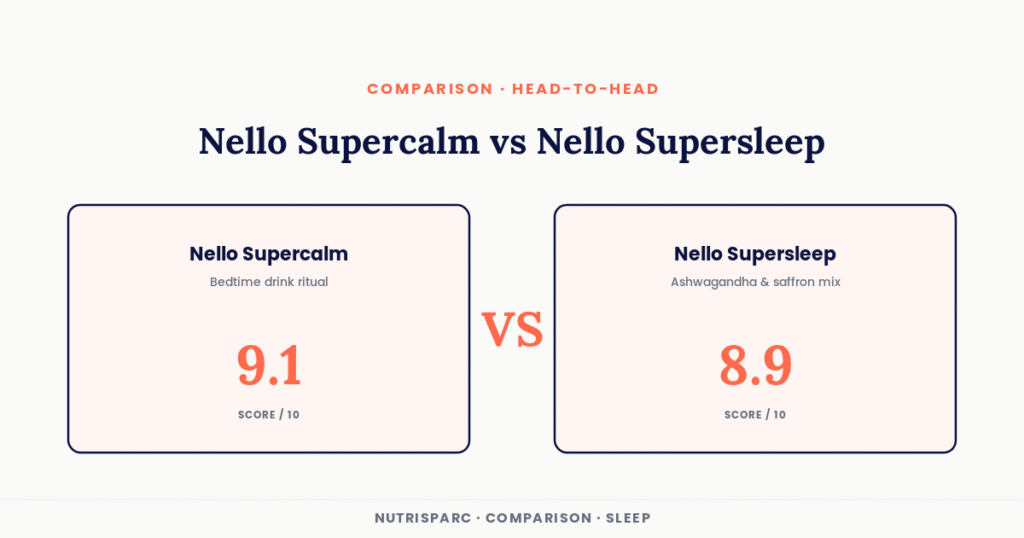
Nello Supercalm (bedtime drink with ashwagandha & magnesium) vs Nello Supersleep (Maizinol & L-glycine drink mix, melatonin-free). Six-criteria honest test.
NutriSparc is reader-supported. Some links may be affiliate links, meaning we may earn a commission at no extra cost to you. Our comparisons are based on editorial criteria, not commission rates. See our
Affiliate Disclosure.
What's the difference between Nello Supercalm and Nello Supersleep?
Nello Supercalm and Nello Supersleep are both powdered drink mixes from the same brand, but they target different parts of the wind-down process. Nello Supercalm is built around L-theanine, KSM-66 Ashwagandha, magnesium glycinate, and vitamin D3 — a calming, melatonin-free formula meant to ease stress before bed. Nello Supersleep leans on Maizinol, a clinically studied hormone-free sleep ingredient, alongside KSM-66 Ashwagandha, L-glycine, and magnesium glycinate to support sleep onset directly.
The Nello Supercalm vs Nello Supersleep choice often comes down to whether you want broad stress relief (Supercalm) or a formula more targeted at falling asleep (Supersleep). Both are melatonin-free, both mix into water as an on-the-go packet, and both avoid proprietary mega-doses. For broader context on how either fits a calm wind-down routine, see our six-criteria methodology and the Best Sleep Supplements Best Of for category-wide picks.
Our Pick
Nello Supercalm
9.1 / 10
Nello Supercalm edges ahead with a higher overall score (9.1 vs 8.7) thanks to its multi-ingredient stack (L-theanine, ashwagandha, magnesium, vitamin D3) and calming ritual format, though Nello Supersleep remains a strong melatonin-free pick for pure sleep onset support.
Ingredient breakdown: Nello Supercalm vs Nello Supersleep
Both formulas share a foundation of KSM-66 Ashwagandha and magnesium glycinate, but the standout ingredients differ. Nello Supercalm pairs L-theanine with ashwagandha and adds vitamin D3, aiming at calm, focused relaxation rather than sedation. Nello Supersleep swaps in Maizinol, a corn-derived, hormone-free ingredient with clinical research behind it for sleep quality, plus L-glycine, an amino acid associated with easier sleep onset.
Neither product uses melatonin, so neither carries the grogginess risk associated with high-dose melatonin gummies. Both are sold as powdered drink mixes in on-the-go packets — Supercalm in Raspberry Lemonade, Supersleep in Peach Dream — rather than capsules, which matters if you prefer a bedtime ritual over swallowing pills.
✓
Maizinol — clinically studied hormone-free sleep aid
✓
KSM-66 Ashwagandha for stress management
✓
L-Glycine + Magnesium Glycinate for relaxation
✓
Melatonin-free, Peach Dream flavor
Cons
×
Newer ingredient (Maizinol) with less long-term track record than melatonin
×
No adaptogen-forward daytime flavor option
×
Higher cost per serving than capsule alternatives
Who should choose Nello Supercalm vs Nello Supersleep?
The Nello Supercalm vs Nello Supersleep decision usually splits along three dimensions: primary goal, flavor preference, and how you respond to prior sleep aids.
Choose Nello Supercalm if you want broad evening stress relief with L-theanine and ashwagandha, you like a Raspberry Lemonade flavor, or you want a melatonin-free option that still supports a calming nightly ritual. Choose Nello Supersleep if your main problem is falling asleep rather than winding down, you want to try Maizinol as a hormone-free alternative to melatonin, or you prefer the Peach Dream flavor. Both mix into water, both are melatonin-free, and both cost about the same per 20-count pack, so the choice comes down to which specific outcome — calm or sleep onset — matters more to you.
Bottom line: choosing between Nello Supercalm vs Nello Supersleep
The Nello Supercalm vs Nello Supersleep decision is rarely about which product is « better » in absolute terms — both score within half a point of each other on our six-criteria methodology. The real question in the Nello Supercalm vs Nello Supersleep choice is which approach matches how you sleep, what you’ve tried before, and what you want a sleep supplement to feel like.
Pick Nello Supercalm if you want a melatonin-free option, you respond well to a calming evening ritual, or you’ve found mass-market melatonin pills leave you groggy. The adaptogen breadth (ashwagandha, L-theanine, magnesium, vitamin D3) supports a wider set of sleep difficulties than melatonin alone, and the warm-drink format becomes part of the wind-down rather than another pill to swallow. Read our full Nello Supercalm review for the criterion-by-criterion breakdown.
Pick Nello Supersleep if you want a formula built around Maizinol — a hormone-free, clinically studied sleep ingredient — rather than adaptogenic herbs, you respond well to L-glycine for sleep onset, and you’d rather skip melatonin-shortcut ingredients entirely. Magnesium glycinate is dosed for deeper sleep quality, and the formula skips fillers and synthetic additives entirely. See our Nello Supersleep review for full context.
Neither product is the right fit for chronic sleep disorders or sleep tied to medical conditions — those need professional evaluation, not supplements. For broader options across the silo, the Best Sleep Supplements Best Of covers other category-leading picks beyond the Nello Supercalm vs Nello Supersleep matchup, and the Sleep silo tracks every review and guide we’ve published in this space.
Whichever you choose, the Nello Supercalm vs Nello Supersleep comparison illustrates a recurring theme on NutriSparc: in a category dominated by 5–10 mg melatonin shortcuts, both products skip melatonin entirely in favor of adaptogens and amino acids — Nello Supercalm leans on ashwagandha and L-theanine, while Nello Supersleep leans on Maizinol and L-glycine. That alone places both above most of what you’ll find on a drugstore shelf.
A note on third-party testing in Nello Supercalm vs Nello Supersleep
Both brands publish third-party testing summaries, which is more than you’ll get from most supplement makers. Our methodology rewards transparency on testing because supplement labels alone are unreliable — the FDA does not pre-approve dietary supplements, and post-market enforcement is limited. Independent lab testing (whether through NSF Certified for Sport, USP, Informed Sport, or third-party COAs) is the closest thing to assurance that what’s on the label is what’s in the bottle.
If sleep difficulty persists for more than three weeks despite supplementation, lifestyle adjustments, and consistent sleep hygiene, that’s a signal to see a clinician rather than try a different product. Sleep is too central to health to troubleshoot indefinitely with stack rotations.
Is Nello Supercalm or Nello Supersleep better for stress-related insomnia?
Nello Supercalm leans slightly toward stress-related sleep difficulty due to its ashwagandha, L-theanine, and magnesium content — ingredients more associated with calm than with direct sleep induction. Nello Supersleep is more useful when the underlying issue involves winding down with Maizinoland L-glycine rather than an adaptogen-heavy blend.
Can I take Nello Supercalm and Nello Supersleep together?
We don’t recommend stacking sleep supplements without medical guidance. Both contain magnesium, and combining them would risk excessive intake. Choose one or the other based on your priorities (adaptogen-based vs. Maizinol-based formula, flavor, ritual). If you’re unsure, speak with a healthcare professional.
Do either contain high-dose melatonin?
No. Both Nello Supercalm and Nello Supersleep are completely melatonin-free. Nello Supercalm relies on ashwagandha, L-theanine, and magnesium, while Nello Supersleep relies on Maizinol, magnesium glycinate, and L-glycine — an approach that skips melatonin’s grogginess risk altogether.
Which is better value: Nello Supercalm or Nello Supersleep?
On strict cost-per-serving, Nello Supersleep is cheaper and includes a 30-day guarantee. Nello Supercalm costs more per serving but includes more actives, multiple flavors, and the experiential value of a hot drink ritual. Pure cost favors Nello Supersleep; ingredient density and ritual experience favor Nello Supercalm.
Editorial & Affiliate Disclaimer:
NutriSparc content is for informational and educational purposes only and is not medical advice.
We may earn a commission from qualifying purchases made through links on this page, at no extra cost to you.
See our
Affiliate Disclosure
and
Editorial Policy.