
Learning how to choose foundational supplements comes down to one principle: focus on filling real nutritional gaps rather than chasing trends. The U.S. National Institutes of Health Office of Dietary Supplements defines dietary supplements as products intended to add nutritional value, but emphasizes that supplementation should complement — not replace — a balanced diet. This NutriSparc guide synthesizes our 18 in-depth supplement reviews, a 6-criteria evaluation framework, and tier-1 evidence from NEJM, Lancet, and JACC to help you identify which foundational supplements genuinely fit your needs — and which to skip.
“Foundational” does not mean everyone needs the same stack. The right choice depends on your diet, lifestyle, health status, medications, lab work, and specific goals. This guide explains how to evaluate foundational supplements without falling for hype.
- Foundational supplements should fill practical gaps, not replace a balanced diet.
- The NutriSparc tier framework organizes 18 reviewed supplements: Tier 1 universal daily, Tier 2 conditional, Tier 3 targeted.
- Label transparency, dose clarity, third-party testing, and ingredient quality matter more than marketing claims.
- More is not always better — fat-soluble vitamins (A, D, E, K), iron, zinc, selenium, iodine, and calcium all have meaningful upper intake limits.
- Lab testing (Vitamin D, B12, ferritin, TSH) prevents both blind supplementation and unnecessary cost.
- People taking medication or managing a medical condition should consult a qualified healthcare professional before starting supplements.
What Are Foundational Supplements?
Foundational supplements are products designed to support basic daily nutrition or common nutrient gaps. Unlike niche supplements that target one specific outcome, foundational products support general wellness, normal body function, or everyday nutritional coverage.
The goal is not to build the biggest supplement stack possible. The goal is to identify what is actually useful, avoid unnecessary overlap, and choose products with clean labels and transparent dosing. Understanding what matters begins with this foundational mindset.
How to Choose Foundational Supplements: A 6-Criteria Framework
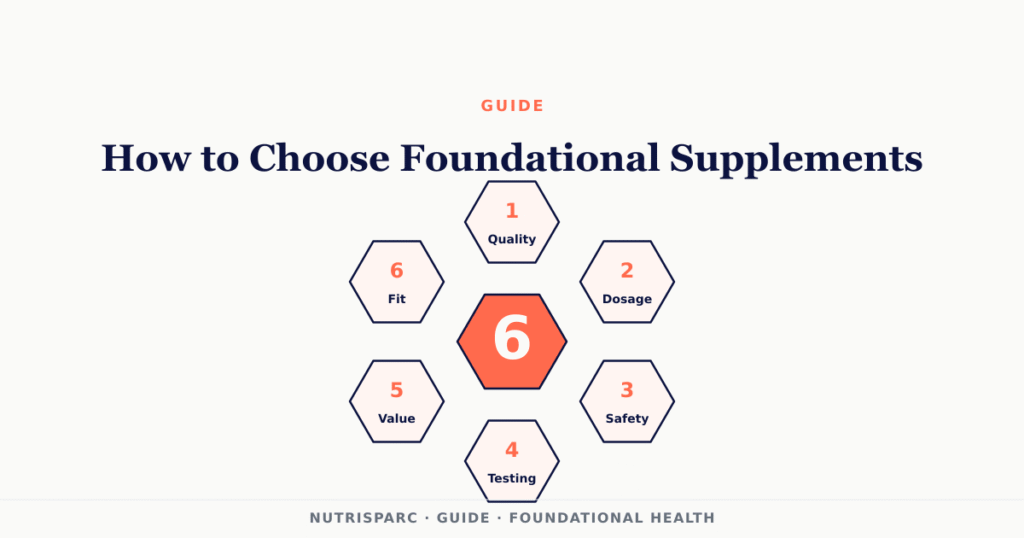
When evaluating your options, our framework evaluates every product on six dimensions — the same criteria we use across our 18 Foundational Health reviews. Each criterion is scored independently, then weighted into a composite score out of 10.
- Ingredient Quality — Bioavailable forms (e.g., magnesium glycinate vs oxide), no proprietary blends, transparent sourcing.
- Dosage Transparency — Exact mg per serving disclosed, matched to RDA/AI/UL per NIH ODS guidelines.
- Safety Profile — Medication interactions documented, UL respected, contraindications clearly stated.
- Testing & Transparency — Third-party testing (NSF, USP, Informed Sport), GMP manufacturing, COA available on request.
- Value for Money — Cost per effective dose, not cost per pill or bottle.
- Overall Fit — Does the supplement match a real, evidence-based need for the user?
For the full scoring methodology, see our scoring methodology page. This framework is the backbone of choosing well consistently across categories.
Tier 1: Universal Daily Foundationals
When comparing options, Tier 1 is where most users should start. These are the supplements most adults can reasonably consider regardless of diet, provided dosing and form are appropriate. Each links to our full review with score breakdown and product comparison.
Magnesium
Magnesium is involved in over 300 enzymatic reactions including muscle function, nerve signaling, and energy metabolism. Per the NIH ODS, approximately 48% of Americans consume less than the Estimated Average Requirement. Form matters significantly: magnesium glycinate is favored for sleep and tolerance, citrate for regularity, oxide for cost (but lower absorption around 4%).
👉 Read our full Magnesium Glycinate Review
Vitamin D3
Vitamin D3 status is widely suboptimal in populations with limited sun exposure, darker winter months, or restrictive diets. Holick 2007 NEJM established its central role in calcium absorption and bone health. Testing 25(OH)D before high-dose supplementation is best practice — the VITAL trial (Manson 2019 NEJM) suggested most benefits cluster in deficient populations rather than universal supplementation.
👉 Read our full Vitamin D3 Review
Omega-3 (EPA/DHA)
EPA and DHA support cardiovascular and cognitive function. Look for combined EPA+DHA totals (not just “fish oil mg”) and third-party oxidation testing. Algae-derived options serve vegan users with comparable bioavailability.
👉 Read our full Omega-3 Supplement Review
Multivitamin
A well-formulated multivitamin can serve as nutritional insurance for users with variable diet quality. The Physicians’ Health Study II (Sesso 2012 JAMA) found modest cancer risk reduction in middle-aged men with daily multivitamin use over 11+ years of follow-up, though benefits in well-nourished healthy adults are limited.
👉 Read our full Multivitamin Review
Protein Powder
Protein supplementation supports muscle protein synthesis, satiety, and sarcopenia prevention in older adults. Morton 2018 BJSM meta-analysis confirmed efficacy at 1.6 g/kg/day total intake for resistance-trained individuals. Whey, casein, and plant blends all work when dosed adequately.
👉 Read our full Protein Powder Review
Tier 1 covers the highest-confidence foundationals — but knowing what matters doesn’t stop at universal picks.
Tier 2: Conditional Foundationals
Tier 2 supplements require more nuance in choosing products that match your context. They make sense for many but not all users — diet, training load, and life stage matter more than universal recommendation.
Creatine Monohydrate
The most evidence-backed performance supplement (Kreider 2017 JISSN position stand). 3-5 g/day creatine monohydrate supports strength, lean mass, and emerging cognitive benefits in older adults.
👉 Read our Creatine Monohydrate Review
Dietary Fiber
Most adults fall well below the 25-38 g/day Adequate Intake per NIH ODS. Reynolds 2019 Lancet meta-analysis associated higher fiber intake with reduced cardiovascular and metabolic mortality. Psyllium, inulin, and acacia fiber serve different gut goals — each suits different users.
👉 Read our Fiber Supplement Review
Electrolyte Powder
Relevant for endurance athletes, hot climates, low-carb diets, or heavy sweating. Sodium 500-1000 mg/serving is typical; “trace mineral” hype is largely irrelevant compared to sodium, potassium, and magnesium content.
👉 Read our Electrolyte Powder Review
Vitamin C
Carr 2017 Nutrients reviewed Vitamin C’s antioxidant and immune roles. The 75-90 mg/day RDA is met by most diets — supplementation is most useful in low-intake populations or smokers (who have approximately 35 mg/day higher needs).
👉 Read our Vitamin C Supplement Review
Vitamin K2 (MK-7)
MK-7 form supports bone and cardiovascular health via gamma-carboxylation of osteocalcin and matrix Gla protein (Knapen 2013 Osteoporosis International). Critical caution: contraindicated with warfarin and other vitamin K antagonist anticoagulants.
👉 Read our Vitamin K2 Supplement Review
Vitamin B12
Essential for nerve function and red blood cell formation. Vegans, vegetarians, older adults (atrophic gastritis), and metformin users are at elevated deficiency risk per Stabler 2013 NEJM. Methylcobalamin and cyanocobalamin both work; sublingual offers absorption flexibility.
👉 Read our Vitamin B12 Supplement Review
Tier 2 introduces real personalization into your choices, where dietary patterns and life stages drive product selection.
Tier 3: Targeted Foundationals
For Tier 3 supplements, knowing the right pick means knowing when not to take them. These products warrant specific clinical justification or documented dietary gaps. Evidence is strong in targeted contexts but routine use is rarely indicated for healthy adults.
Calcium
Bolland 2015 BMJ raised cardiovascular concerns with high-dose calcium supplementation, particularly without vitamin D co-administration. Food-first approach (dairy, leafy greens, fortified foods) preferred when possible; supplementation primarily for documented inadequate intake.
👉 Read our Calcium Supplement Review
Zinc
Essential trace mineral with strong evidence for immune function and common cold duration (Hemilä 2013 Cochrane). UL is 40 mg/day to avoid copper depletion — a meaningful concern with long-term high-dose use.
👉 Read our Zinc Supplement Review
Iron
Pasricha 2021 Lancet Haematology emphasized iron deficiency anemia diagnosis (ferritin testing) before supplementation. Pediatric iron poisoning remains the leading cause of supplement-related poisoning deaths in young children — products must be locked away from children.
👉 Read our Iron Supplement Review
Selenium
Schomburg 2012 Nature Reviews Endocrinology documented selenium’s role in selenoprotein function. UL is 400 mcg/day to avoid selenosis — Stranges 2007 Annals of Internal Medicine reported brittle nails, hair loss, and gastrointestinal effects at excessive intakes.
👉 Read our Selenium Supplement Review
Iodine
Pearce 2016 Lancet Diabetes & Endocrinology described iodine’s U-shaped intake-disease curve: both deficiency and excess cause thyroid dysfunction. Pregnancy and lactation needs are elevated; kelp products show extreme variability and should generally be avoided in favor of standardized potassium iodide.
👉 Read our Iodine Supplement Review
CoQ10
The Mortensen 2014 Q-SYMBIO trial (JACC Heart Failure) showed 300 mg/day CoQ10 reduced cardiovascular mortality in chronic heart failure under cardiology supervision. Statin-myalgia context per Skarlovnik 2014. Endogenous synthesis declines with age and statin use.
👉 Read our CoQ10 Supplement Review
Choline
Wallace 2018 Nutrients found approximately 90% of Americans below the Adequate Intake threshold. Pregnancy AI rises to 450 mg/day for fetal brain development (Zeisel 2009 Annual Review of Nutrition). The TMAO cardiovascular debate (Tang 2013 NEJM) warrants caution at high doses without clinical indication.
👉 Read our Choline Supplement Review
With Tier 3, the question of which to prioritize often becomes the question of whether to take them at all without clinical guidance.
How to Build Your Foundational Stack
There is no universal stack. Use this decision tree to identify candidates worth discussing with your healthcare provider — and remember that knowing what to look for starts with matching products to real, documented gaps.
The Healthy Mixed-Diet Adult
Most users in this profile genuinely need very little. For this group, the approach reduces to a short, evidence-led list. Consider: Vitamin D3 if testing shows low 25(OH)D, Omega-3 if fatty fish intake is less than 2 servings per week, Magnesium glycinate if sleep or muscle tension is recurrent.
The Plant-Based / Vegan Adult
Higher-priority candidates: Vitamin B12 (essential, not optional), Vitamin D3 (vegan-sourced lichen D3 available), Omega-3 (algae-derived EPA+DHA), Iron (women especially), Iodine (no iodized salt routine), Zinc (lower bioavailability from plant sources), Choline (eggs are the top food source — vegans frequently fall short).
The Older Adult (50+)
Sarcopenia prevention shifts protein needs to approximately 1.2-1.6 g/kg/day. Vitamin D3 absorption declines. B12 absorption is impaired by atrophic gastritis. CoQ10 endogenous synthesis declines (relevant if statin therapy is initiated).
The Endurance Athlete
Electrolytes (sodium loss in sweat), Creatine (cognitive + muscle), Protein (post-training synthesis window), Iron (women especially — risk of low ferritin), Magnesium (cramping prevention in heat).
The Pregnancy / Lactation Context
Healthcare-provider-guided. Prenatal vitamin (folic acid, iron, iodine), Choline (often underdosed in prenatals — AI rises to 450 mg/day pregnancy, 550 mg/day lactation), Omega-3 DHA (fetal neurodevelopment), Vitamin D3.
Common Foundational Supplement Mistakes
Even with a solid grasp of the essentials, these six patterns trip up most buyers — including experienced supplement users.
- Stacking overlapping multivitamins, prenatals, and individual supplements — Easy to exceed the Upper Intake Level for fat-soluble vitamins (A, D, E, K) or trace minerals (zinc, selenium) without realizing.
- Chasing megadoses without indication — More is rarely better. UL is not optimal dose. Vitamin D3 50,000 IU weekly is for documented deficiency under clinical supervision, not maintenance.
- Ignoring form bioavailability — Magnesium oxide is around 4% absorbed; glycinate is 4-8× better. Iron sulfate causes GI distress; bisglycinate is gentler. Folate as 5-MTHF over folic acid for MTHFR polymorphism carriers.
- Skipping baseline testing — Vitamin D, B12, ferritin, and TSH testing identifies real gaps. Supplementing blindly wastes money and risks UL excess.
- Trusting “proprietary blend” labels — Hidden doses make evaluation impossible. Walk past any product hiding active amounts in a blend.
- Treating supplements as substitutes for diet, sleep, and exercise — No supplement compensates for poor foundations. Address those first.
Who Should Be Careful?
Knowing what matters also means knowing when to pause. Some users should be especially cautious before starting foundational supplements, including:
- People taking prescription medication (warfarin, statins, metformin, levothyroxine, immunosuppressants)
- Pregnant or nursing individuals
- People with kidney disease or liver disease
- People using anticoagulants
- People with diagnosed nutrient deficiencies requiring medical supervision
- People already taking multiple supplements with overlapping ingredients
- Children under 18 (especially regarding iron products — keep locked)
When in doubt, speak with a qualified healthcare professional before adding a new supplement.
Final Verdict
Foundational supplements can be useful, but they should be chosen carefully. Getting this right is less about products and more about process: identify gaps, match evidence to need, and stay sceptical of marketing. The best products are not the loudest or most complicated. They are transparent, well-dosed, tested when possible, and matched to a real need.
For most people, the smartest approach is not building a giant stack. It is a small, intentional approach: identify the gap, choose a clean formula, avoid overlap, and reassess over time.
Frequently Asked Questions
How do you choose foundational supplements?
To choose well, start by identifying actual nutritional gaps through diet review, lab testing (Vitamin D, B12, ferritin, TSH), and lifestyle context. Apply our 6-criteria framework: Ingredient Quality, Dosage Transparency, Safety Profile, Testing & Transparency, Value, and Overall Fit. Tier 1 (Magnesium, Vit D3, Omega-3, Multivitamin, Protein) covers most adults; Tier 2 (Creatine, Fiber, Electrolytes, Vit C, Vit K2, B12) depends on lifestyle; Tier 3 (Calcium, Zinc, Iron, Selenium, Iodine, CoQ10, Choline) needs clinical justification. Always consult a qualified healthcare professional before starting any new supplement.
What are the most important foundational supplements?
Tier 1 foundational supplements with the strongest evidence base are Magnesium (300+ enzymatic reactions), Vitamin D3 (calcium absorption and bone health per Holick 2007 NEJM), Omega-3 EPA/DHA (cardiovascular and cognitive), a well-formulated Multivitamin (PHS-II trial, Sesso 2012 JAMA), and Protein Powder for users with elevated needs (Morton 2018 BJSM). However, “most important” varies by individual diet, age, activity level, and health context.
Should everyone take a multivitamin?
No. A well-formulated multivitamin can serve as nutritional insurance for users with variable diet quality, restrictive diets, or absorption issues. The PHS-II trial (Sesso 2012 JAMA, 11+ year follow-up) found modest cancer risk reduction with daily multivitamin use in middle-aged men, but routine multivitamin use in well-nourished healthy adults shows minimal benefit. Quality matters more than quantity: reasonable daily values, bioavailable mineral forms (no oxide-only blends), no iron unless indicated.
What should I check first on a supplement label?
Apply this 5-item label audit: (1) Ingredient form (magnesium glycinate vs oxide, B12 methylcobalamin vs cyanocobalamin) — bioavailability differs dramatically, (2) Exact dose per serving in mg/mcg/IU — not “complex” or “blend”, (3) Third-party testing seals (NSF, USP, Informed Sport, ConsumerLab), (4) GMP manufacturing facility disclosure, (5) Avoidance of “proprietary blend” labeling that hides active amounts. If any of these are missing, the product is harder to evaluate confidently.
Can you take too many supplements?
Yes. Stacking overlapping multivitamins, prenatals, and individual supplements easily exceeds tolerable upper intake levels (UL) — especially for fat-soluble vitamins (A, D, E, K), iron (pediatric poisoning is the leading cause of supplement-related deaths in young children), zinc (copper depletion), selenium (selenosis), iodine (thyroid dysfunction), and calcium (Bolland 2015 BMJ cardiovascular concerns). Map every active ingredient across your current routine before adding new products. When in doubt, consult a registered dietitian or healthcare provider.
Do I need lab testing before starting supplements?
Testing isn’t always required but is highly recommended for: Vitamin D3 (25(OH)D test before supplementation greater than 2000 IU/day), Vitamin B12 (B12 plus methylmalonic acid for ambiguous cases per Stabler 2013 NEJM), Iron (ferritin and transferrin saturation — Pasricha 2021 Lancet Haematology recommends diagnosis before iron repletion), Thyroid function (TSH before iodine supplementation), and Comprehensive metabolic panel if kidney or liver disease is suspected. Testing prevents both under-treatment of deficiency and UL excess from blind supplementation.
Sources
- National Institutes of Health, Office of Dietary Supplements — Complete dietary supplement fact sheet directory.
- Holick M.F. (2007). Vitamin D deficiency. New England Journal of Medicine 357(3):266–281.
- Sesso H.D. et al. (2012). Multivitamins in the prevention of cancer in men: the Physicians’ Health Study II randomized controlled trial. JAMA 308(18):1871–1880.
- Reynolds A. et al. (2019). Carbohydrate quality and human health: a series of systematic reviews and meta-analyses. Lancet 393(10170):434–445.
- Bolland M.J. et al. (2015). Calcium intake and risk of fracture: systematic review. BMJ 351:h4580.
- Morton R.W. et al. (2018). A systematic review, meta-analysis and meta-regression of the effect of protein supplementation on resistance training-induced gains in muscle mass and strength. British Journal of Sports Medicine 52(6):376–384.
- Mortensen S.A. et al. (2014). The effect of coenzyme Q10 on morbidity and mortality in chronic heart failure: results from Q-SYMBIO. JACC: Heart Failure 2(6):641–649.
- Examine.com — independent supplement research database.