
Learning how to choose a creatine supplement should be simple — creatine is one of the most-studied supplements in sports nutrition — but the market makes it confusing. Exotic forms, proprietary blends, gummies, and “enhanced” formulas all compete for attention against a plain ingredient that already works. This guide explains what the evidence actually supports, which label details matter, and where the premium options earn their price.
- Creatine monohydrate is the form with the deepest evidence base — newer forms have not shown better results, only higher prices.
- The effective dose is 3-5 g per day, taken consistently. Timing matters far less than consistency, and a loading phase is optional.
- Third-party certification (NSF Certified for Sport, Informed Choice) is the main quality differentiator between otherwise identical powders.
- Single-ingredient powders are easier to assess than blends — you can see exactly what you are paying for.
- Creatine is well studied and well tolerated in healthy adults, but people with kidney conditions should talk to a healthcare professional first.
What Is Creatine (and What Does It Actually Do)?
Creatine is a compound your body already produces and stores mostly in muscle, where it helps regenerate ATP — the immediate energy currency used in short, intense efforts. Supplementing raises muscle creatine stores, which research consistently links to better performance in repeated high-intensity work, and to greater strength and lean-mass gains when combined with resistance training.
Two things follow from that mechanism. First, creatine is not a stimulant: you will not feel it the day you take it; stores build over weeks. Second, the benefit depends on training — creatine supports work you actually do, it does not replace it.
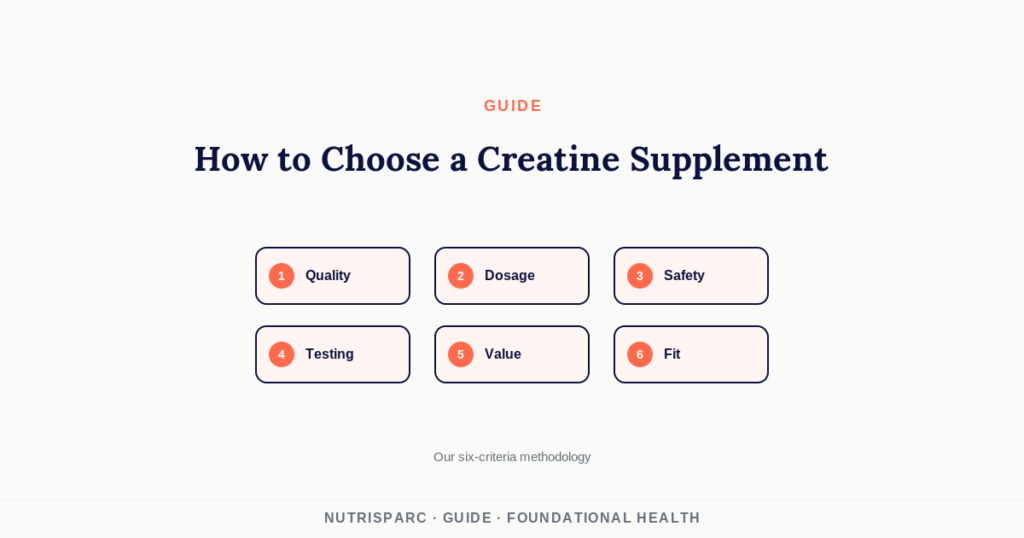
How to Choose a Creatine Supplement: A 6-Criteria Framework
We evaluate every creatine product with the same six-criteria methodology we use across the site. Applied to this category, the criteria look like this:
- Ingredient quality. Form (monohydrate vs others), sourcing, and whether the formula is a clean single ingredient.
- Dosage transparency. A clear per-serving dose — 3-5 g — with no proprietary blend hiding the number.
- Evidence alignment. Does the product match what research supports, or does it lean on unproven add-ons?
- Safety profile. Clean excipient list; no unnecessary sweeteners or stimulants bundled in.
- Testing & transparency. Third-party certification and how granular it is (every-batch vs lot-level).
- Value for money. Price per effective dose — not per container.
The Forms of Creatine: Does Anything Beat Monohydrate?
Creatine monohydrate
The reference form, used in the overwhelming majority of studies behind creatine’s reputation (see the ISSN position stand, Kreider et al. 2017). It is stable, effective, and cheap. “Micronized” monohydrate is the same molecule milled finer so it mixes better — a convenience improvement, not a performance one.
Creatine HCl
More water-soluble, often sold as “no bloating, smaller dose.” The dissolution claim is true in a glass of water; the superiority claims are not established in outcome studies. You pay more per gram for equal or unproven benefit.
Buffered creatine (Kre-Alkalyn)
Marketed as surviving stomach acid better. Head-to-head research has not shown an advantage over monohydrate at matched doses.
Blends and “performance formulas”
Creatine mixed with amino acids, betaine, or stimulants. These make dose comparison difficult and often under-dose the creatine itself. If you want other ingredients, buying them separately keeps every dose visible.
Bottom line: choose monohydrate — micronized if you mix it in water — and spend any extra budget on certification, not form.
The Label Details That Actually Matter
1. Dose per serving
Look for 3-5 g of creatine monohydrate per serving. Gummies and capsules often need 5-7 units to reach that dose — check the math before judging the price.
2. Third-party certification
Powders are commodity products, so quality assurance is the real differentiator. NSF Certified for Sport tests every batch against banned substances and label claims; Informed Choice certifies through periodic lot testing. For tested athletes, every-batch certification is the safer standard. Certifications change — verify the current logo on the label, not on a review.
3. Sourcing
Creapure is a German-made creatine monohydrate with a long purity track record; some brands use it, many use generic sources that also test fine. Sourcing is a tiebreaker, not a requirement.
4. What else is in the tub
The best creatine labels are one line long. Flavored versions add sweeteners and acids — fine if you prefer them, but unflavored monohydrate disappears into any shake.
How to Use Creatine
Daily dose: 3-5 g, every day, training day or not. Loading (optional): 20 g/day split over 5-7 days fills stores faster; a steady 3-5 g reaches the same place in about a month. Timing: research shows little meaningful difference — pick a moment you will not forget. With what: water, a shake, anything; taking it with a meal is fine. Expect noticeable effects after 2-4 weeks of consistent use, not on day one.
Powder vs Capsules vs Gummies
The format question is mostly a price and accuracy question. Unflavored powder is our top pick: cheapest per dose, easy to verify (one scoop = one declared dose), and it dissolves into anything. Capsules deliver the same molecule with more convenience and a markup — typically 4-7 capsules to reach 5 g, so check the count before assuming a bottle is a month’s supply. Gummies are the weakest format on current evidence: independent testing in the category has repeatedly found products with far less creatine than labeled, sometimes none, because creatine is difficult to keep stable in a gummy matrix. If you choose gummies anyway, prefer a third-party-tested brand and treat the declared dose with healthy skepticism.
One more practical note: creatine degrades in liquid over time, so pre-mixed creatine drinks and “creatine waters” raise the same stability question. Mixing powder fresh is the reliable route.
Creatine for Different Users
Beginners
Skip the loading phase, start at 3-5 g daily with any meal, and judge nothing for a month. The most common beginner error is evaluating creatine on a caffeine timeline.
Vegetarians and vegans
Dietary creatine comes mostly from meat and fish, so vegetarians tend to start with lower muscle stores — and studies often show them responding more noticeably to supplementation. Creatine supplements themselves are synthetic and vegan-friendly; check the capsule shell if you choose capsules.
Women
The evidence base includes women and shows the same direction of effect. The water-weight concern is usually overstated: the 0.5-1.5 kg early increase is intracellular water in muscle, not bloating, and it stabilizes.
Older adults
Research on creatine combined with resistance training in older adults shows support for maintaining strength and lean mass. The same kidney-function caveat applies more often in this group — a quick conversation with a doctor is worth it, especially alongside other medications.
Top Creatine Picks
We maintain a ranked lineup in our best creatine monohydrate supplements page. The short version: Thorne Creatine (9.3) leads on every-batch NSF Certified for Sport testing; Optimum Nutrition Micronized Creatine (8.8) is the dependable mainstream pick; Nutricost (8.4) wins on price per dose; MuscleTech Platinum (8.2) is a solid simple alternative. All four are micronized monohydrate — exactly what this guide recommends.
Common Creatine Mistakes
- Paying extra for exotic forms. No form has out-performed monohydrate in matched-dose research.
- Treating loading as mandatory. It is a speed option, not a requirement — and it causes most of the digestive complaints people attribute to creatine.
- Quitting after a week. Stores take weeks to saturate; the timeline is built into the mechanism.
- Skipping rest days. Saturation depends on daily intake, not training schedule.
- Ignoring the per-dose math on gummies and capsules. Convenient formats often cost 3-5× more per effective dose, and gummy creatine content has been a recurring testing problem in the category.
Who Should Be Careful?
Creatine has a strong safety record in healthy adults at standard doses (Antonio et al. 2021). That said: people with kidney disease or impaired kidney function should not supplement without medical guidance; adolescents should involve a parent and a professional; and anyone taking medication that affects the kidneys should ask first. A modest early weight increase from water retention in muscle is normal and expected. This guide is educational — not medical advice.
Final Verdict
Choosing a creatine supplement well is mostly about refusing to overpay. The evidence points to one form (monohydrate), one dose (3-5 g daily), and one real differentiator (third-party testing). Decide how much certification matters for your situation — every-batch for tested athletes, lot-level for most others — pick a clean single-ingredient powder, and let consistency do the rest. Always verify the dose and certification marks on the current label of the exact product you buy.
Frequently Asked Questions
Is creatine safe to take long term?
Long-term studies in healthy adults at standard doses have not shown harm, and creatine is among the best-studied supplements available (ISSN position stand, 2017). People with kidney conditions are the main exception and should seek medical guidance first.
Do I need to cycle creatine?
No. There is no evidence that cycling improves results or that continuous use at 3-5 g per day causes problems in healthy users. Your body’s own production resumes normally if you stop.
Does creatine cause water retention and weight gain?
Creatine pulls water into muscle cells, so a small early weight increase (often 0.5-1.5 kg) is common and expected. This is intracellular water in muscle, not the “puffy” subcutaneous kind, and it stabilizes quickly.
Does creatine cause hair loss?
The concern traces back to a single small 2009 study that found higher DHT levels in rugby players — it did not measure hair loss, and the finding has not been replicated. Current reviews (Antonio et al. 2021) find no direct evidence linking creatine to hair loss. If you are personally concerned, talk to a healthcare professional.
When is the best time to take creatine?
The honest answer: whenever you will reliably remember it. Studies comparing pre- vs post-workout timing show small, inconsistent differences. Daily consistency is the variable that actually drives results.
Is creatine natural — do I get it from food?
Yes. Your body makes about 1 g per day, and a meat- and fish-containing diet adds roughly another 1-2 g. Supplementation simply tops up muscle stores beyond what diet practically provides — which is why vegetarians often notice more from it.
Can I take creatine with caffeine or pre-workout?
Yes. Early concerns about caffeine “blocking” creatine came from one small study and have not held up in subsequent research. Many pre-workouts already include creatine — count that toward your daily total rather than doubling up.
Sources
- Kreider, R.B. et al. (2017). International Society of Sports Nutrition position stand: safety and efficacy of creatine supplementation in exercise, sport, and medicine. JISSN.
- Antonio, J. et al. (2021). Common questions and misconceptions about creatine supplementation: what does the scientific evidence really show? JISSN.
- Examine.com — Creatine reference page.