
Learning how to choose a magnesium supplement starts with one unglamorous concept: elemental magnesium. The same word on two bottles can mean very different delivered doses, and the form attached to the magnesium decides how well you absorb it and how your gut tolerates it. This guide covers the forms worth knowing, the label math that prevents overpaying, and the cautions that actually matter.
- Compare elemental magnesium per serving — the milligrams of actual magnesium, not of the whole compound.
- Glycinate/bisglycinate is the well-tolerated default; citrate is a solid value option; oxide is poorly absorbed and mostly useful as a laxative.
- Typical supplemental range is 200-400 mg elemental per day; more is not better and increases digestive side effects.
- “Magnesium glycinate” blends sometimes hide oxide in the mix — read the supplement-facts panel, not the product name.
- People with kidney disease and anyone on interacting medications should involve a professional before supplementing.
What Does Magnesium Actually Do?
Magnesium is a cofactor in hundreds of enzymatic reactions — muscle and nerve function, energy production, sleep-adjacent pathways. Intakes below recommended levels are common in Western diets, which is why magnesium earns a legitimate place in the foundational category. That said, supplement benefits show up most clearly when intake or status is actually low; magnesium is a correction tool more than an enhancement tool.
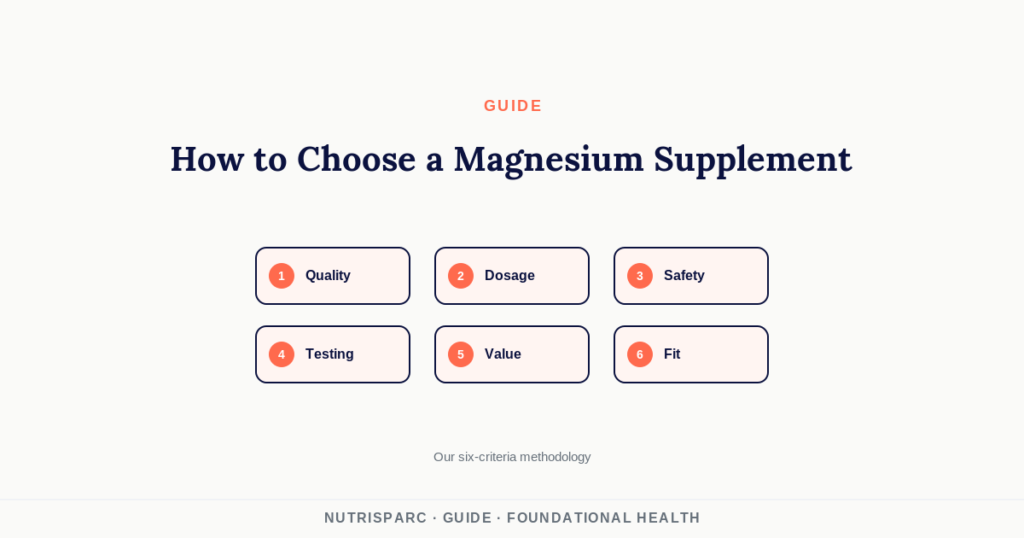
How to Choose a Magnesium Supplement: A 6-Criteria Framework
We score every product with the same six-criteria methodology used across the site. For magnesium:
- Ingredient quality. Which form, and whether the label is honest about it (no hidden oxide in a “glycinate” blend).
- Dosage transparency. Elemental magnesium clearly stated per serving.
- Evidence alignment. Doses in the studied 200-400 mg range, claims that stay factual.
- Safety profile. Gentle forms, sensible doses, clean excipients.
- Testing & transparency. Third-party testing or strong manufacturing credentials (NSF facilities, USP, COAs).
- Value for money. Price per milligram of elemental magnesium in the form you actually want.
The Forms of Magnesium, Honestly Ranked for Most Users
Glycinate / bisglycinate
Magnesium bound to glycine. Well absorbed, the gentlest on digestion, and the default recommendation for general use and evening routines. “Bisglycinate” and “glycinate” describe the same chelate; “buffered” versions cut it with oxide — check the panel.
Citrate
Well absorbed and cheaper, with a mild laxative effect at higher doses that some users actually want. The best value pick if your gut tolerates it.
Oxide
The highest elemental percentage on paper and the worst absorption in practice — useful as an occasional laxative, a poor choice for raising magnesium status. Its job in many cheap products is making the label number look big.
Malate, taurate, threonate
Niche forms with specific rationales (energy pathways, cardiovascular research interest, brain penetration in animal models for threonate). Evidence in humans is thinner and prices are higher — reasonable experiments, not defaults.
The Label Math: Elemental Magnesium
Magnesium glycinate is mostly glycine by weight — roughly 10-14% elemental magnesium. So “2,000 mg magnesium bisglycinate” may deliver ~200 mg of actual magnesium, while a label that just says “Magnesium 200 mg” has already done the math for you. Good brands state elemental clearly (for example, Thorne’s powder declares ~200 mg elemental per serving). When two products look wildly different in price, this is usually why. Capsule count matters too: many glycinate products need 2-4 capsules per declared serving.
Top Magnesium Picks
Our ranked lineup lives in the best magnesium glycinate supplements page. The short version: Thorne Magnesium Bisglycinate (8.8) leads on form and manufacturing credentials; Pure Encapsulations (8.7) is the hypoallergenic clean-label pick; NOW Foods (8.5) wins on value; Nature Made High Absorption (8.1) is the accessible pharmacy option.
Common Magnesium Mistakes
- Buying the compound number. “2,000 mg” of a chelate is not 2,000 mg of magnesium — find the elemental line.
- Choosing oxide for daily status. Cheap per bottle, expensive per absorbed milligram.
- Megadosing for faster results. Above ~350 mg supplemental elemental, digestive upset rises; the answer to “not working yet” is rarely “more.”
- Ignoring the rest of the stack. Multivitamins, electrolyte mixes, and sleep formulas often each add magnesium — total it before adding a dedicated product.
- Expecting sedation. Magnesium supports normal function; it is not a sleeping pill, and treating it like one leads to disappointment or overdosing.
Who Should Be Careful?
People with kidney disease should not supplement magnesium without medical guidance — impaired excretion is the main route to genuinely high levels. Magnesium can also interact with several medication classes (some antibiotics, bisphosphonates, certain blood-pressure medications) by affecting absorption timing; separating doses by a few hours is the usual advice, but the specifics belong with a pharmacist or doctor. Early signs of too much: loose stools first, and that is your dose ceiling speaking. This guide is educational — not medical advice.
Final Verdict
Choosing a magnesium supplement well is three decisions: a form that suits your gut and goal (glycinate as the default, citrate for value), a dose inside the studied 200-400 mg elemental range, and a brand transparent enough to state elemental content and back it with testing or credentials. Everything else on the bottle is decoration. Verify the supplement-facts panel of the exact product you buy — formulations and capsule counts change.
Frequently Asked Questions
Which magnesium is best for sleep?
Glycinate is the most common evening choice — well absorbed, gentle, and the glycine itself is studied in sleep contexts. The honest framing: evidence supports magnesium helping when status is low, not acting as a universal sleep aid. Our Sleep section covers dedicated options.
Magnesium glycinate vs citrate — which should I buy?
Glycinate if digestive comfort is the priority or doses are higher; citrate if value matters and your gut is robust. Both absorb well; oxide is the form to avoid for status purposes.
Can I take magnesium every day?
Daily use at 200-400 mg elemental is standard practice for healthy adults and reflects how the research doses it. The kidney-disease caveat is the main exception.
When should I take magnesium?
Whenever you will take it consistently. Evening is popular for routine reasons, with food helps tolerance, and away from interacting medications if you take any. Timing finesse matters far less than daily consistency.
Do I even need a supplement, or just better food?
Nuts, seeds, legumes, whole grains, and leafy greens are strong magnesium sources — many people can close the gap with diet. A supplement is the pragmatic tool when eating patterns will not realistically change.
Sources
- NIH Office of Dietary Supplements — Magnesium: Fact Sheet for Health Professionals.
- Boyle, N.B. et al. (2017). The Effects of Magnesium Supplementation on Subjective Anxiety and Stress — A Systematic Review. Nutrients.
- Examine.com — Magnesium reference page.